Alhagie Touray, AB Sailors’ Union of the Pacific (SUP)
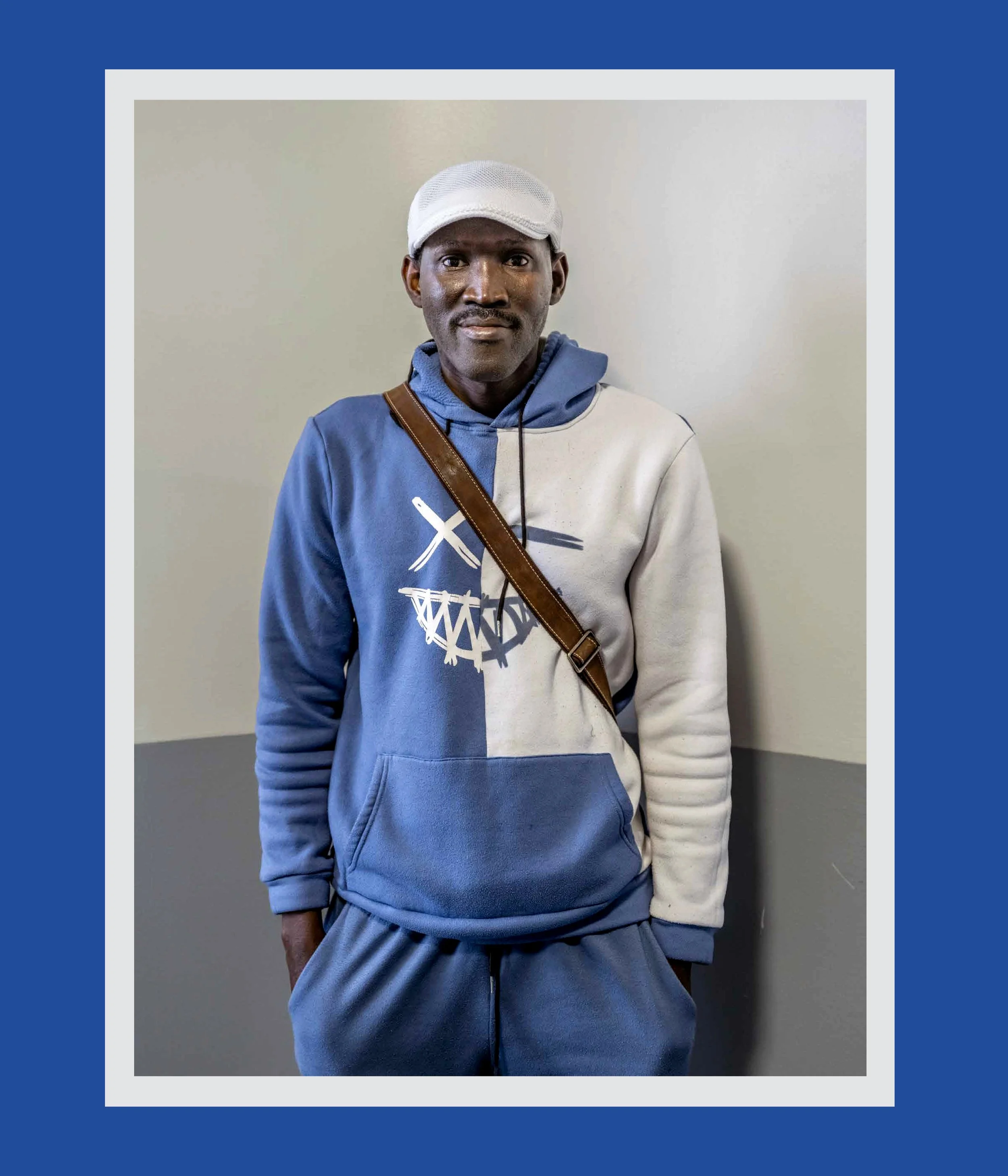
Alhagie Touray, AB Sailors’ Union of the Pacific (SUP) hiring hall, San Francisco, California. 06 June, 2026
“This was maybe very early in the morning, maybe around 2 to 3 a.m. Captains, no matter how much they are sleeping, they pay a lot of attention to what is going on around them. The ship was going so crazy he ran, he ran from his stateroom, and come up on the bridge. I was on the wheel, and you know he just kicked me out from the wheel.”
My name is Alhagie Touray, and I sail as AB, able-bodied seaman. I'm deck, and I'm under the captain. I work with the captain.
My job depends on the assignment I take at the time. But usually I take a watch stander assignment. It's either watch stander or day man.
If you are day man, that is maintenance. You work on deck, maintenance in the winches, and some moving parts on the ship, painting, and so forth.
But if you're doing watch stander you are always on the bridge. You work with the captain, mostly steering. Usually we only steer when we are coming to port through the channel. So I do that steering, it’s called helmsman or quartermaster.
While at sea, whereby we don't steer, we put it on autopilot, so I will be there helping the mates, watching radars, and so on.
..
Watches, they cut it into four-four that way you are not fatigued, that’s Coast Guard rules and regulations. My last ship that I work 04 to 08, and then 16:00 to 20:00. So I have my eight hours. In between I do my overtime, if there is any.
That's my favorite watch. Usually you can have enough sleep. Let's say I start in the morning at 4, I’ll be on the bridge till 0745. My relief will come who will start from 8 to 12. So from 8 I go have my breakfast.
Then 8 o'clock to midday I can do my overtime which is three hours, four hours, mostly four hours. Once I do that I have my lunch. So I still have enough time to rest before 3.45. Then 3.45, I go back to the bridge again.
So that's very convenient for me. I have enough time to sleep, and I have enough time to rest after my overtime in the afternoon before I go back on the bridge.
Usually I work with the bosun, the bosun is the head on deck. Whatever he got, mostly if there's any painting job, if there's any chipping or maintenancing the winches that we use to hold the mooring lines. Yeah, so stuff like that, cleaning, whatever is available.
..
I've been sailing for about 13 years now. All with SUP.
It's (sailing) something that meant to be. I have no sailor in my family. I know nothing about it. But it's something that meant to be when I started working at Chevron Refinery in Richmond.
So I was working there in the refinery, and I interact with the sailors of Chevron tankers when they come to the refinery. The company I'm working for at the time, I was doing security at the refinery, and sometimes I will go do gangway security for them.
They look like they're making good money. So when I start talking to them, and then they tell me if you want, we can help you.
They were so kind to me, they list the stuff that I need to do for my STCW (Standards of Training, Certification and Watchkeeping). So when they list that the captains were very happy because they see how keen I was to be a part of them. A lot of young kids used to say (they were interested) over there, but they never do it. But the way I was saying it, they have a feeling that I'm ready to do it.
So when they gave me those lists, they said, if you got those we're going to make you start with us. Several of them are under SUP too, so I went to get my STCW at Cal Maritime.
Once I got that, when I came back, I sorted them with my TWIC card and I applied for MMC, Merchant Marine Documents, the licenses for you to sail from Coast Guard. It's like a small book passport, orange.
Once I got those they were like, wow, you're the man. And yeah, they helped me. I started with them. I sail with them for like one and a half year.
Then I stopped sailing (with them). I continued with SUP because, the thing is, I don't like chemicals, and working on tankers you're dealing with chemicals everyday. Since then, I was working with SUP.
..
When I moved directly without sailing for Chevron I was mostly doing military, a lot of military.
I was on United States Naval ship USNS Sisler, about three times in Diego Garcia, the island in the Indian Ocean.
Then I was on the USNS Dahl. At the time, Dahl was in Saipan. I was there for like four months.
Then I was on USNS Charleston, at the time in Busan, in South Korea, for like another four months.
So my last military ship was USNS Dahl in Saipan in November 2019. Since then I'm just sailing containers, APL [American Presidents Line] going China, Japan, Korea, crossing the Pacific back and forth to California.
Then I sail sometimes with Matson [on the] Triangle, back and forth Honolulu, Seattle, Washington, Oakland, back and forth, yeah.
..
I was sailing during COVID. Oh, it was tough! At the same time we made a lot of money because at that time we have something called restriction pay. If you are in the port, you are not allowed to go out, the company has to pay you for that. So we make a lot of money out of that. The restriction pay was overtime, it’s not even regular.
So during COVID when we are in U.S. ports, we don't go out. We are in L.A. or Oakland, those are the two ports in the U.S. (on the west coast), the overtime start at 3 p.m. ‘till the following morning. You have to stay on the ship. But this is overtime for you so this bring tons of money for us during that time. That's the only good part.
The bad part was restriction. You can’t go out.
..
When I'm at sea I'm away from dramas, you know. At sea (I’m) just focusing on my job and saving money because when you're on the ship you don't spend money. So away from dramas, not only away from dramas, but saving money as well.
If you compare to somebody who is at home 9 to 5,
going back to work you have to pay off well if you're driving yourself. If you're taking train, you still have to buy your ticket for train. So, I’m not doing all that. All I do is do my work.
After my work hours, if I want to rest I go to my stateroom. When it is time for work, I just go to work. So within that period, I'm away from drama and at the same time saving money too.
That's the good part I like. Also the scenery at sea, it’s only my job you can get that unless you pay for it, you take a cruise ship. So I'm seeing that, and getting paid.
..
I live in Oakland. I have an apartment there, a family with me over there. So when I'm home I have a place that I'm staying. I'm paying rent.
Mostly I will sail six months or more a year, sometimes seven months, eight months.
[Maintaining a family is] very difficult with this type of job because you are always away. That’s the challenge of this type of job. But once the family is used to it, they cope with it because they see the potential, like the type of money you're making. They are used to your schedule, they're good with it because they know this particular time you will be away, then this particular time you will be at home.
Once they get used to it, it's just normal to them. But before that point it's a little bit difficult.
..
My favorite places that I've been to since I started this job, number one favorite was Singapore. Then my number two favorite was Auckland, New Zealand. Yeah, those are my two favorite places.
And then going through Panama Canal, for quite some time, also was very interesting.
The least favorite will be maybe Diego Garcia. Nothing there, it’s a military island. So the people you see every day, that's all you see every day.
You know, it's a small environment. We bump into each other because some are military, some are just fellow sailors on different ships. So nothing there, nothing, nothing.
..
[Onboard] there can be some dramas, depending on the crew. Sometimes you will have very, very excellent crew. And then sometimes you will have some, maybe one or two depending on the situation … then there will be some dramas. You know, that's life, some people are drama in nature. So if you happen to sail with somebody like that, then you will have some dramas.
(Sailors) we try to treat each other as brother and sister. In the SUP umbrella we call it SUP Brotherhood. Yeah, we try to maintain that when we are at sea.
..
Yes, yes, we do trade stories. One of places like that was Diego Garcia because you have different unions, different ships, different contracts. But at the same time, we end up hanging out at the same place.
I could remember when I was there back in the days. When I leave my ship as an SUP member with another SUP member, then we go hang out. We will meet some SIU [Seafarers International Union] sailors, another union on different ships. We’ll hang out and exchange our stories about our union, the advantages and disadvantages. You know, what SUP is good for over SIU, what SIU is good for over SUP. Yeah, we exchange those things.
Favorite story about sailing? A lot of stories, I don't know which one I will pick as favorite one, but there was a story on
one of the ships that I was on. This was my last ship on military. We were coming from Saipan, going to Bayonne, New Jersey dry dock.
At the time I was a watch stander, that’s 12 midnight to 4 in the morning, and 12:00 to 1600 (in the afternoon). My watch partner, he was third mate. Kind of a little bit new. Maybe from the academy, so less experience.
We left Saipan, came through Panama Canal, then to Jacksonville, Florida. There we have to unload all the military trucks, or hardware that we have onboard because the ship going to the dry dock has to go empty.
We unload everything in Jacksonville, and then we have a crew change and (new) captain. The captain that I sailed with went home from Jacksonville.
Then the other captain came and took over. His name was Captain Hood. He was hardcore. I heard about him before because he fires many people, even from our union.
The funniest thing about that - when you come to the ship the first thing he will tell you is, “I fired 29 people and I'm looking for the 30th before I retire.” So that's it. I mean, that makes you like hope I'm not going to be that 30th one.
So we left Jacksonville, we were coming to Bayonne. He want us to go around outside New York to kill the time because we are a little bit ahead of schedule. This was November, and
the sea was very rough and the ship was empty. What does that tell you? When the sea is rough and the ship is empty, it's light, it's moving around like crazy.
The waves, that's mate's area. I know a little bit about it, but that's not my area. If waves are so high like that there is a way to minimize the movement of the ship, and that's mate's area. So anyway I was under him.
When the sea is that rough we will take it from the autopilot. And then here comes my job, to steer it, and to minimize the movement.
I guess because he was new and less experienced the way he was directing me was even making the movement worse.
This was maybe very early in the morning, maybe around 2 to 3 a.m. Captains, no matter how much they are sleeping, they pay a lot of attention to what is going on around them. The ship was going so crazy he ran, he ran from his stateroom, and come up on the bridge. I was on the wheel, and you know he just kicked me out from the wheel.
The mate was bold enough to tell the captain, “No, no, it has nothing to do with him. It's me. I'm the one directing him. So put all the blame on me.”
So the captain took over the steering from me, and control the ship till it's steady, moving smoothly - the movement stopped.
Then it was a lot of yelling because everything was on the floor. The whole galley the plates were all on deck, broken plates, glasses, cups. It was a mess, and the captain was not happy.
This is the captain that was saying, “I fired 29 people. I'm looking for 30”. So I was wondering, I believe the mate was wondering, maybe one of us will be the 30th. Or maybe both of us, but fortunately I think he understand that, you know, we can all make errors. So he let it go.
I really give credit to the mate with his boldness and said, “It's all on me, has nothing with Haji. Haji is just doing his job. I'm directing him and he's following my directions. So nothing to do with him.”
Yeah, so I was glad that he stand on that and then everything went well with him also. Sometimes, if you are honest it try to correct everything at the end of the day, and that's what happened.
That was my last military ship, and that was the sea story I had.
..
The weather, especially end of the year and beginning of the year - November all the way to March - we have rough seas.
I think the worst, one of the worst that I've been on was coming from Honolulu, going to Seattle. Ah always bad, very bad. November, December 2024, I was on one of Matson's ships, Mahi Mahi. I nearly lost my finger, one of my fingers because the ship was moving so bad.
I left my stateroom, I think I was going to eat, and the door was slamming. I tried to hold it because I was going out, and I feel like if I don't hold it, it might slam on me. So I tried to hold it but the force of the movement of the ship …, I couldn't be able to control it. The door slammed on my finger, almost cut one of my fingers.
I have to see the medical personnel on board, which is second mate, to see what kind of medical attention I might need so that I don't get infected, and she took good care of it.
Then after was like a week, everything went back to normal. I was actually lucky because they were telling me people lose their fingers like that. They were telling me one story that the same ship, somebody lose their finger like that.
So, yeah, November especially coming from Seattle, from Honolulu to Seattle, all the ones that I've been, that's the worst one.
..
I sail with one of my shipmates before. He cannot get up.
Like in the morning he's like, I don't know if you can call it sleepyhead. So that was funny.
Let's say we're supposed to work at eight o'clock in the morning. He would start putting his alarm clock, 3 o'clock,
3:30, 4 o'clock, 4:30, 5 o'clock, 5:30, 6 o'clock, 6:30. They would all come and go off.
This man cannot get up. So the guy next door to him was so mad because the alarm kept waking him up, and he bring it to the chief mate that he cannot take it. So from there, we have to call him. Somebody has to go knock his door before the time. By doing that we charge him for that. Anybody who is going to call him, he has to pay them $20 just to wake him up. All of us, we are like, I have to be the guy who is supposed to make that $20.
Yeah, that was another funny sea story. That was in Diego Garcia.
..
The only sea monster I would say I've seen, those are just whales. Yeah, whales. A lot of whales. Especially the same route I was saying is always rough - coming from Honolulu to Seattle, there are a lot of whales at that time. And sometimes when we are in Santa Barbara Channel, going to L.A. These are special areas, they call them whale zone. When we are coming there and everybody knows that's a whale zone, so we have to look for them so that we don't hit them.
Those are the areas that I usually will say, if I see a sea monster those are the sea monsters that I see.
..
Alhagie Touray, AB (SUP)
..
Photo: Robert Gumpert
…