John Robertson, chief mate Master, Mates, & Pilots (MM&P)
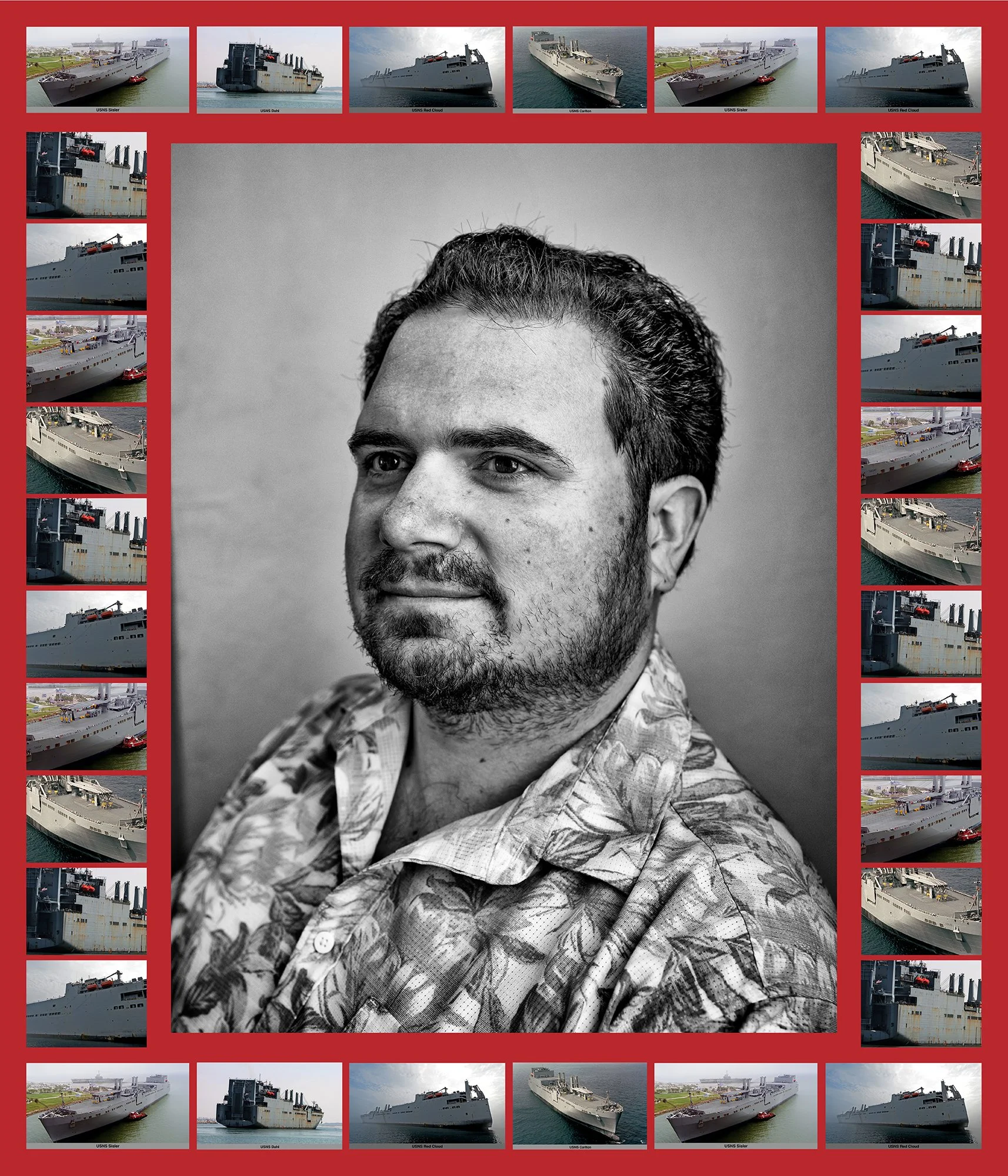
John Robertson, chief mate. MM&P hiring hall, Oakland, California. 18 November, 2025
“There can be friction between the guys on the port and the guys on the ship. They want (the cargo), and we have different priorities.
I’m concerned with the ship. When I unload a lot of times I'm doing it in tandem with people from the military. For their reasons they want this piece, that piece, but I can't give you everything out of the bottom of the ship, and leave everything on top because the ship will turn over.
That's called stability, right? But they don't know about stability. They just know that they need this right now, and they don't need that until later.”
I grew up in San Francisco, and I had a gamut of high school jobs. I was a lifeguard, I worked in different forms of education with elementary school kids and preschool kids.
I wanted to run away and get on somebody's sailboat and go to Hawaii. But I was the oldest of my generation, so my mother plunked me into college in Menlo Park, and it was a business school. I went in for liberal arts and by a year or two I decided this is not really it, and so I came out of that.
Eventually I ended up with a temp-to-hire job with a firm called Expediters International. They're a freight forwarding company so they handle the logistics of freight. They don't own a ship. They don't own a container. They don't own a truck. They just own computers. They have a lot of people that do customs and they do import/export. I ended up in the ocean import team and I burned out in about two years. Cubicles and ties weren't for me.
I was back to being a bum. I was working in a climbing gym and that was a lot of fun, but not a career.
..
I love being on the water. When I was in high school here in San Francisco I volunteered with a non-profit called Blue Water Foundation. They have a couple of sailboats over in San Francisco, and they take kids from the city out because so many kids in San Francisco have never been on the water. You know, there's kind of a big barrier to entry there, especially to get on a sailboat.
That birthed my interest in being on the water, and I think that definitely was part of the inroad to being open to going to Cal Maritime. I felt, well I know I'm okay on a boat, those guys (Blue Water Foundation) keep asking me to come back…
Cal Maritime was sort of a path for me to complete the college requirement but also be on the water, and somehow I pulled it off. I started sailing in 2014 and I’ve been at sea about half of the time since then.
..
I don't currently own or rent a home in the United States. I spend half my time on the ship, and I come through here and I stay at my mom's in San Francisco. And then my off time I travel wherever I feel like going. Sometimes I'll pop down sort of temporary roots somewhere - an Airbnb, or a short-term rental in the Philippines, Thailand or Korea.
I get to go to these places on the ship but you're always tied to the ship. So even though the contracts I work I get significantly more shore time than a container ship contract, you still have to always be back. You have to be up, you have to be at work the next day. It's not the same as being able to go around and travel the way most people think of it.
..
I work on the USNS LMSR (Large, Medium-Speed Roll-on/Roll-off operated by Sealift Command) program. I’m on the Sisler now, but (I’ve been) on the Dahl, the Charlton, the Red Cloud - they're large RoRo ships - so-roll-on, roll-off-cargo.
It's all government cargo, part of a pre-positioning program. We're full of Humvees and trucks and supplies for the military. They keep us over there so they can fly the people over to meet the ship. Then we can go somewhere faster than if we left from the west or the east coast.
The reality of our pre-positioning mission is that we pretty much stay in one place until they send us to another place - to stay in one place. Historically it's either been Saipan - a small island north of Guam. Or Diego Garcia, an atoll not even on island in the Indian Ocean. Or somewhere in Korea. They have a few parking spots, and for the most part these ships stay in those places.
..
In terms of best and worst ports, I never went to Diego Garcia. But I hear it's a bit boring there and that's why I avoided it.
This last year we got to do a mission to the Philippines, and that was something new and fun. I've had pretty good times in Saipan - there's tons of beaches and swimming, and a bit of nightlife, and enough of a local population for it to have a culture.
Korea's a lot of fun. Korean food is really good, but that place is definitely, … you're more of a foreigner there.
..
It’s a hard question to answer why I like being on the ocean. I mean, you get beautiful sunrises and sunsets every day of the week. Check out any mariner’s Instagram page for at least 40 of those.
It's a different work-life balance. We work 120 days back to back. You don't take Saturday and Sunday off. That means I get 100 or 120 days where I don't work. There's a little bit of training and stuff you have to handle while you're not on the ship, but for the most part I get these big blocks of time.
I’ll talk to friends and they're like “I don't understand how you can work for four months straight?” I look at that person, and I'm how do you work 40 hours a week, 52 weeks a year, with maybe two weeks of vacation you can't even shove together into one block of time?
It's a very interesting career in that it's part industrial, part blue collar, part white collar. There's a lot of rules and regulations and knowledge. There's math if you're navigating. You're always doing math, that’s what navigation is. There's kind of a romantic angle to it. Although once it becomes a reality, that can be easy to lose sight of.
And then just getting to go around the world. I mean, you can look at a map, the Pacific Ocean looks pretty big. But if you actually get on a ship and cross it you realize it's massive, and we're very small. So, yeah, there's a lot of benefits to it.
..
You can absolutely get antsy and I think I've adapted. My friends who I've talked to have the same feeling you get towards the end of a hitch - I can't wait to get off this thing. And towards the end of vacation, like I am now, you think man I can't wait to get back to the ship.
A challenge for me will be whenever I stop sailing, trying to settle down in one place. I think I'll manage, but I've definitely fallen into a pattern of I'll be here, and then I'm going there. Then I'm going back to the ship, and then I'm going to vacation, training, and back to the ship. There's a rhythm to it.
..
I’m employed on a contract. I'm not shipping off the board anymore because I promoted to chief mate, and I got hired. I'm now considered a company employee.
The first time I took the chief mate position on the Sizzler, I took it because it was open. It was available, and they didn't have someone. Then once I did that hitch earlier this year they offered I could come back if I wanted. And I accepted that.
..
If I had to say what makes one ship better than another it would be people.
We've all worked for people we didn't get along with. Or people who are some type of mean or cruel, or just not good at their job. If they're above you, not good at their job, and you rely on them for your job, you know - it's a nice way of saying some captains are assholes!
..
I've worked mostly one class of vessel. I've been on other ships, but the Watson class is definitely where I've spent a majority of my time.
They can be quirky. They're built one at a time, all built to the same plan. They have idiosyncrasies, but for the most part they all manage the same. Again, it’s more (the) people because you kind of learn which ones have been better taken care of, and unfortunately some are better taken care of than others.
..
Because it's the Pre-Po [Pre-Purchase Order] thing, and people kind of joke about this, but a lot of the times we get to port and we don't load or unload anything except for fuel, stores and trash. We’re basically a floating warehouse. We do load and unload, just not as frequently as the guys who are doing it every port.
There can be friction between the guys on the port and the guys on the ship. They want (the cargo), and we have different priorities.
I’m concerned with the ship. When I unload a lot of times I'm doing it in tandem with people from the military. For their reasons they want this piece, that piece, but I can't give you everything out of the bottom of the ship, and leave everything on top because the ship will turn over.
That's called stability, right? But they don't know about stability. They just know that they need this right now, and they don't need that until later. The guy who loaded the ship didn't know that they were going to want that a year and a half down the road. So then we have to sort of de-conflict.
Then if you're somewhere foreign … Let's say we're not unloading in the States, then you've got all the local longshoremen, the local regulators and agents, and you have to deal with them too. And maybe they dictate a schedule that doesn't fit what we're trying to accomplish. So there can be conflict there.
With container ships, that’s a different ballgame. I’ve worked a few what night-mate (jobs) on them here in Oakland, and in Los Angeles, but I haven't shipped on one. I haven't made my career there, but I can tell you that they have load planners.
We have load planners as well, but the difference is when you come onto a RoRo you're driving a car into a parking spot and there's wiggle room with that. But the container is going into this hold and this bay and this tier. It's like Tetris. So the port with the cranes puts the containers in. They just have to have a certain level of trust that they're doing what they're saying they're doing, and those boxes weigh what they say they weigh. There's definitely some wiggle room there.
..
John Robertson, chief mate MM&P
..
Photo: Robert Gumpert
Transcription: Michele Colyer
…