Dan Marks, MM&P Sailing 41 years, generally as Chief Mate
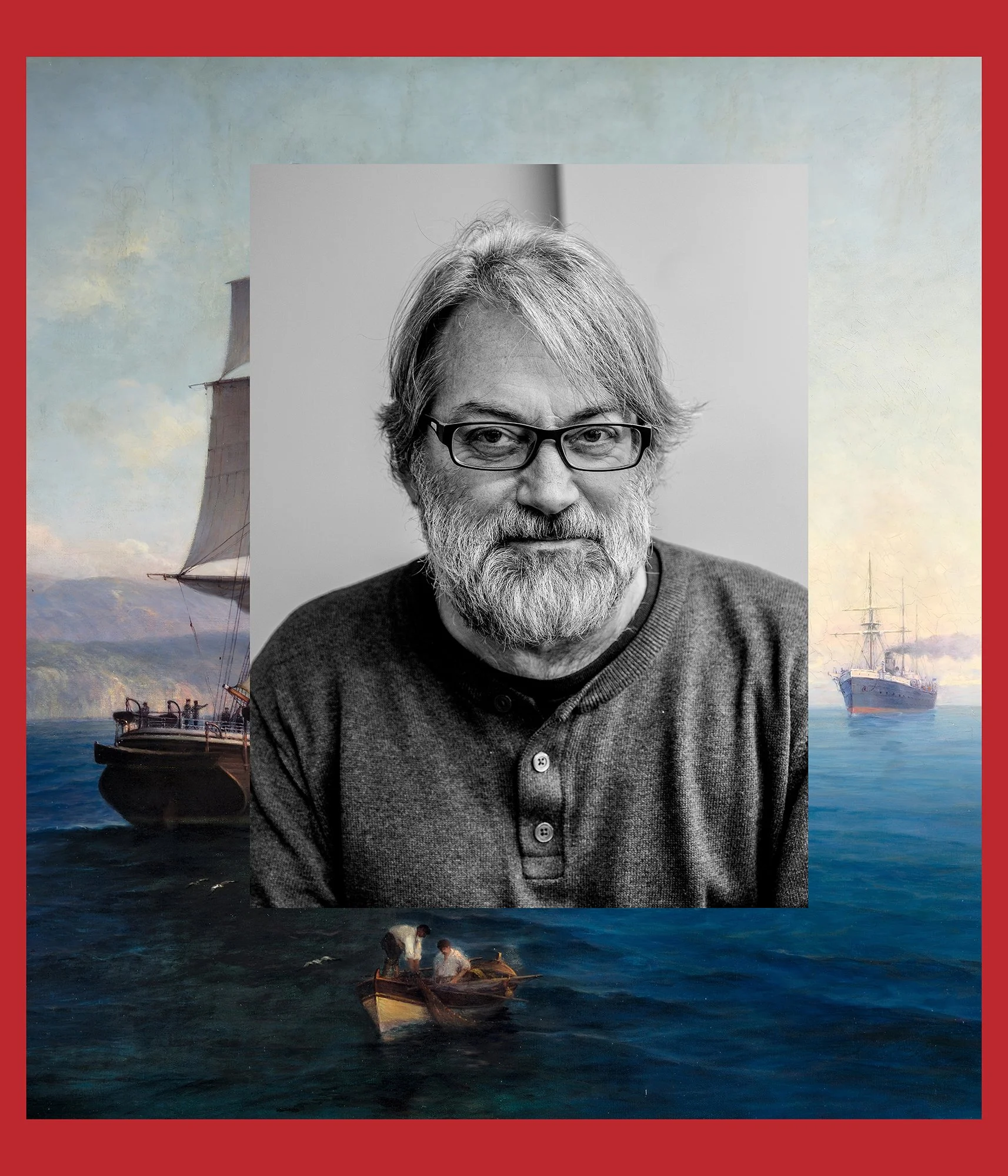
Dan Marks, MM&P Sailing 41 years, generally as Chief Mate. MM&P hiring hall - Wilmington, California. 20 January, 2026
I like sailing. It goes back to the whole basics of the experience. You are more in touch with why your ship is moving and how you affect the ship moving.
On a big metal ship with an engine, the engine goes and you can go to bed, watch a movie. There's not a whole lot of interrelation there other than you get the electricity from the generator that makes your TV work. That's not a big connection really.
I was in high school, and I was bored. Actually, I was out with my friend one day, and I went to my girlfriend's high school, and we got arrested for trespassing.
I ended up being on probation for six months after graduation. While I was sitting around at 2 in the morning watching movies, trying to figure out where my life was going to end up, I saw a commercial for the Coast Guard.
I figured I could do that for four years while I made up my mind, and they pretty much taught me everything I needed to know for getting into the maritime business.
(I first shipped as) seaman apprentice while I was Coast Guard. Seaman apprentice was a rate.
..
After that the only boat I had seen that I thought I could get a job on was a NOAA [National Oceanic and Atmospheric Administration] ship. I'd been stationed up in Alaska with the Coast Guard, and we played softball with the NOAA ships that came up. I thought if I want to go back to Alaska I better work for NOAA. Of course, as soon as I got the job with NOAA we went down to the equator and over to Hawaii. So it took me a while to get back up to Alaska.
I was a deckhand then, similar to the rate in the Coast Guard, only without as much responsibility. You show up for work, chip and paint, sort the garbage, steer, look out.
I was 16 years non-union. In 1997 I was working on the landing craft up in Prince William Sound (Alaska) as a limited tonnage mate relieving a friend who wanted to take some vacation. I worked up there for about four or five months.
We went to the yard in Seward, and the Coast Guard came on to do the COI [Certificate of Inspection]. They asked us if we had our STCW [International Convention on Standards of Training, Certification, and Watch-keeping]. What they did was they took our documents and our licenses back to their office in Anchorage and they got some STCWs for us. This was like first generation STCW - 1978 model. No picture on it, just a brief description of what it covered. And they sent that back to us before we ever left the shipyard there.
At that point I knew I was going to need a lot more training than I could afford on my own. So, in 2000 I joined SIU - Seamen’s International Union - as an AB and got some unlimited time [an AB Unlimited endorsement means you have zero restrictions on the size or tonnage of the vessel you can work on], so I could up my license (as a mate).
..
When I was in the Coast Guard there was basically three departments. It's kind of similar to what it is in the merchant fleet. There's the deck department, engineering department, and the operations department.
The deck department's all the deck hands, and that's usually led by some bosun mates and a warrant bosun, at least on the size ship I was on.
Engineering department has a bunch of unlicensed engineers, and they had some petty officers above them in different ratings, and then warrant officers in charge of their department. So as they're coming up, they've got all these years of experience teaching them what they're supposed to be doing.
In the operations department, there are no seamen or firemen. There's petty officers who've already gone to their school for their rating, and because of that you’ve already been in for awhile. The people in charge of the operations department are boot ensigns right out of the academy. So, you know, they come out of the academy, they come to the ship, and they're put in charge of all these guys who've been sailing for a while.
Somebody plants this bug in their ear that they need to straighten these guys up because their hair's too long. They're unshaven. Their uniforms look sloppy, and they're not polishing their shoes.
I was in Alaska, good luck polishing your shoes. I had salt stains on my shoes and you couldn't see my hair most of the time because we're wearing parkas. But you know every single time you get a boot ensign he's we need to do things by the book. That's great, except the book is a general suggestion for the entire fleet, not for your specific boat. And the way you do things is usually based on your boat, and the years that we spend on the boat.
In the merchant fleet everyone's got different experience. Some of the guys come to the academy after they’ve worked on boats when they were younger. I’ve had people come out of the academy who probably should have gone and worked as a deckhand for a while. But I've also had guys who haven't even graduated from the academy, who are still cadets, and who are able to stand a watch better than somebody who's been in for a long time as a second or third mate.
..
I think my main problem is I was stationed in Alaska when I first started. Alaska taught me you're going to have to learn how to rely on yourself, trust yourself. That big wave comes and something's going to happen pretty quick. Nobody's going to be able to get between you and that wave before that thing happens.
If you get to a point where you are in situations where you can really learn to trust yourself, rely on your abilities, discover the abilities you're lacking, I think it'll tend to lean you in the direction that you do that more often. And I think that's why a lot of guys are out on the water.
..
Standing watch, that can be the most exciting thing in the world, or it can be the boringest thing in the world.
When I started out two seaman apprentices would go up to the bridge - one guy would go up on the flying bridge, out in the weather. He would be lookout (with) your pair of binoculars and big jacket. The other guy’s on the wheel. You trade out every hour.
The buoy tenders that I was on were built either during WW2 or before WW2. There was mechanical linkage from that wheel down to the hydraulics in the steering room. Definitely no autopilot.
The most exciting part about it is when you see something you've never seen before. If you're lucky, somebody told you what you might be seeing, so you recognize it when you see it. If not, it's like somebody that's never seen a manatee or knows what a manatee is, and they think it's a mermaid.
Up on the flying bridge as lookout, one of the most exciting, educational things that ever happened to me was when I was up on Lake Michigan. We had just left Milwaukee, and the officer on watch called up and asked me if I saw these lights, and why didn't I report it?
They were far away, and didn't think they mattered. He said, you report all the lights.
I stared at them for a long time, and he stared at them for a long time, and he looked at the radar. After a while he came back. We had a brass voice tube that came up that we talked to each other with, and he said that's Michigan, 70 miles away. Then he commenced to explain it to me.
I've seen it a lot with radio waves since, but this was one of the first times I'd seen it visually where you have visual ducting. You have a temperature inversion and we are underneath the top of it. The light is bouncing back and forth along the surface of the earth and 70 miles away you shouldn't be able to see because it's not a straight line.
Up in Puget Sound, and some other places where the water’s cold and the air is hot - or vice versa - you get a little pocket right down by the water and you'll get the Fata Morgana. I don't know if you've ever heard of that, you get a reflection of the sky, (and) it looks like the ship is floating around in the sky. The other version of that is where if you're on top of the layer instead of underneath. You're still getting that reflection but you're getting it in a different direction.
Those are always fun because you try to figure out how far away it really is.
..
I like sailing. It goes back to the whole basics of the experience. You are more in touch with why your ship is moving and how you affect the ship moving. You can do a lot of stupid stuff that would probably get you really hurt if you didn't know exactly what you were doing.
On a big metal ship with an engine, the engine goes and you can go to bed, watch a movie. There's not a whole lot of interrelation there other than you get the electricity from the generator that makes your TV work. That's not a big connection really.
But if you're on a sailing ship how you tweak the sail depends on how fast you go. Of course, it's a little more labor intensive, so you're spending a lot more of your time doing all that. You also have to pay attention to it, because if the wind changes, your course changes and you have to adjust the sails.
You have to have awareness about what the weather is, what it's going to be. You don't have time to wait until it changes to do something.
You can break boat parts if you're not paying attention. There's a reason on the sailing ship the cockpit is in the back - it’s so you can see everything that's going on in front of you.
..
I wouldn’t say I’ve sailed everywhere, but I’ve been to a lot of places. More than some, less than others.
Pretty much most ports I'm in are my favorite port. I always tell people Dubai is a good one, but there's lots of other ports I've been to. The ports you go to first on a boat, instead of driving or flying, I think a lot of times end up being your favorite. Maybe not Djibouti. I went to Djibouti first by boat. It's probably not at the top of my list.
We called Dubai the Las Vegas of the Middle East. A typical rotary hitch for us is 120 days and I always tell people I'd do 120 days on a boat just to spend two days in Dubai - the day you show up and the day you leave. There's a lot of stuff to do. It’s a little exotic, but not so exotic that you're trying to find your way from point A to point B and get lost in the culture.
There's lots of other places that you like for what happens to you when you're there. You don't necessarily like them before you get there, but once you're there and you start experiencing it … Istanbul is a great port.
I've been to a lot of little towns in Italy that were fun. Some of them are fun just because you show up and you don't think you can communicate with people.
I live in Texas, you kind of have to know Spanish. So I show up in Italy and I go to a bar and the guy asks me what I want to drink. It's a little cold out, so I decide I want a hot whiskey. I throw out a couple Spanish words that I know mean whiskey and hot water. And he's like, okay. And I'm communicating with the locals!
That actually reminds me of a story on one of the sailing ships. A lot of times when you're sailing with people, you think you can communicate at a different level maybe than reality - but sometimes it's actually true. I was on a boat called the Rose, which is now at the San Diego Maritime Museum.
In 1991, we tied up at just under the World Trade Center, and we got a bunch of Russians on board for some reason, about eight of them. We had a crew of 50, so they were a relatively small part of the crew, but they had sailing experience from back in Russia.
On that particular boat I was an engineer. So I was down in the engine room all the time tending generators, the engine, the batteries, the plumbing, everything. They handed me one of the Russians to work with. I’m thinking this guy's an engineer too, we put on our headphones and go down to the engine room. He starts looking around, he's asking me questions, and I'm giving him answers. And then I'm asking him questions, and he's giving me answers.
That night we come up on deck, and of course the Russians all have their bottle of vodka that they're chugging away at, and we've got our rum that we're chugging away at. Everybody usually gets together and they start singing sea shanties. And for some reason, we're not really doing that because we don't know Russian sea shanties, and they don't know ours.
The crew starts kind of mumbling about not being able to communicate with the Russians, and I’m like I don't know what you guys are talking about, Nick and I get along perfectly. We can talk to each other just fine. I'm like, “Nick, tell ‘em.”
I remember he says something in Russian like he doesn't know what I'm talking about. It dawns on me that we're in the engine room all the time with our earphones on, and we're using hand signals - you know, pointing at something. Give me the screwdriver, pointing at the screwdriver. We're not actually talking, we’re using the universal language.
So sometimes that works. In fact a lot of times that works good in a bar if you don't really know the language.
I was in Columbia one time and the launch left early without us. I'm running around trying to find somebody that can tell me how to get a boat back out to the ship, moored off of the coast.
I run into two guys with machine guns who look like they're in some kind of Colombian military uniform. They're not shy about pointing the guns at me, asking me what I'm doing. It was amazing how much Spanish came out my ass to let them know I worked on a boat and I'm looking for a ride back to my ship. I'm not even sure what I said to them, but it was enough to appease them. That's kind of a funny thing that happens to you.
..
I don't really care where I go. I probably care what the job is. I just came back from a short third mate job, I was out in Honolulu before this looking for a job. There aren’t as many jobs in Honolulu as I thought. There’s lots of night mate work, temporary stuff, day to day, but the actual shipping jobs are fewer and further between.
I ended up taking a 10-day third mate job, Honolulu to Guam, so I didn't have to sit around in Honolulu, pay some crazy rent and drive around in a rent-a-car. They wanted to fly me back to Honolulu. I paid the extra $92 to get myself to Los Angeles.
Our union [MM&P] has a limited number of halls around the country and the LA hall ships more people every month than any other. So if you're going to look for a job this is the place to come looking.
But L.A. is a little different. I would opt more for a chief mate job. Although, if I had been working a lot as chief mate, sometimes I work as second mate because it's like a working vacation. Some guys don't want the responsibility of chief mate. They retire as second mate after shipping for twenty, thirty years.
..
The job I like best I think depends on my mood. I've kind of gotten used to the chief mate thing.
When I was captain, that was pretty easy. It's mostly paperwork, but I hear a lot of captains complain because if you go from boat to boat, you don't necessarily have somebody setting up a routine that makes it easier for you. And there's lots of paperwork you have to do with the crew, with port officials, et cetera.
The couple times I've worked as captain there was a routine in place, and a lot of times it was a routine that I was familiar with because I'd been on the ships as a lesser rank. I knew what they were doing, so when it was my turn I just slipped in, typed everything out on the keyboard, it was easy.
..
I guess it depends on the destination, (but) if you think you're going to be able to go anywhere, those days don't exist anymore.
The ships that work on the West Coast largely go to Hawaii. If you're working out of Seattle they go to Alaska.
Oakland, and Los Angeles - after Hawaii, they continue on sometimes to China, Korea, or Japan.
If it's something that's tramping, that's a different story. They could go anywhere. You don't know where you're going to find yourself. In fact, they may tell you you're going somewhere, and then you don't end up going there. I've been on ships where we were heading in this direction and just before we get to where we're going, they say go that way.
Some tramps are a little trampier than others. It’s an adventure, but it's fun to mixup where you go.
I mean if I was on a regular run to Japan I would love that. I love Japan, and Hawaii is not bad. But you know, if you leave here and you end up in Singapore, or you go to the Philippines, you go to Morocco – Awesome!
It's always fun seeing some place new, sometimes even someplace you've been before. It kind of mixes it up - you’re not just putting on the same clothes and going to the same place.
..
We definitely see stuff happening before it hits the news. When Obama did a surge in Afghanistan, we delivered the strikers from Tacoma to Diego Garcia a month before. And then somebody else picked them up in Diego and took them up to Pakistan. Obviously, Afghanistan doesn't have a port, somebody took them to Pakistan, and I guess the Army drove them into Afghanistan.
And it's true of non-news. If I go to the dealership and some guy is selling me a car I know is made overseas - even if it's in Europe, if he says he can get me a new car from them with the custom paint job I want and all the accessories in five days, it's not coming from Europe. Just the boat trip takes nine days, so I got a little bit of bargaining chip because I know that.
..
I’m still doing this because my wife won't let me retire! And I got a kid coming through college here pretty soon. And I like being on the water.
But with retiring, it's not really about your age. It's about how much time you have in the pension plan. Sailors tell me this all the time, if I’d started in the union at 18 or 20, after 20, 30 years, I could have retired and started a whole other career, and then retired from that.
Filipinos are some of my favorite sailors just from the nature of the fact that they come from somewhere else and have to adapt to our system. They got this thing, like down.
They used to tell me this when I was in the Coast Guard. You should stay in the Coast Guard for 20 years, retire, move to the Philippines, and your money will go a long way. Then if you really want to work, get another job, keep working. And then after you get 20 years in that, retire again.
On that note, we're going to stop.
..
Dan Marks, MM&P Sailing 41 years, generally as Chief Mate
..
Photo: Robert Gumpert
Transcription: Michelle Colyer
…