Beau Gouig, Chief Mate (MM&P)
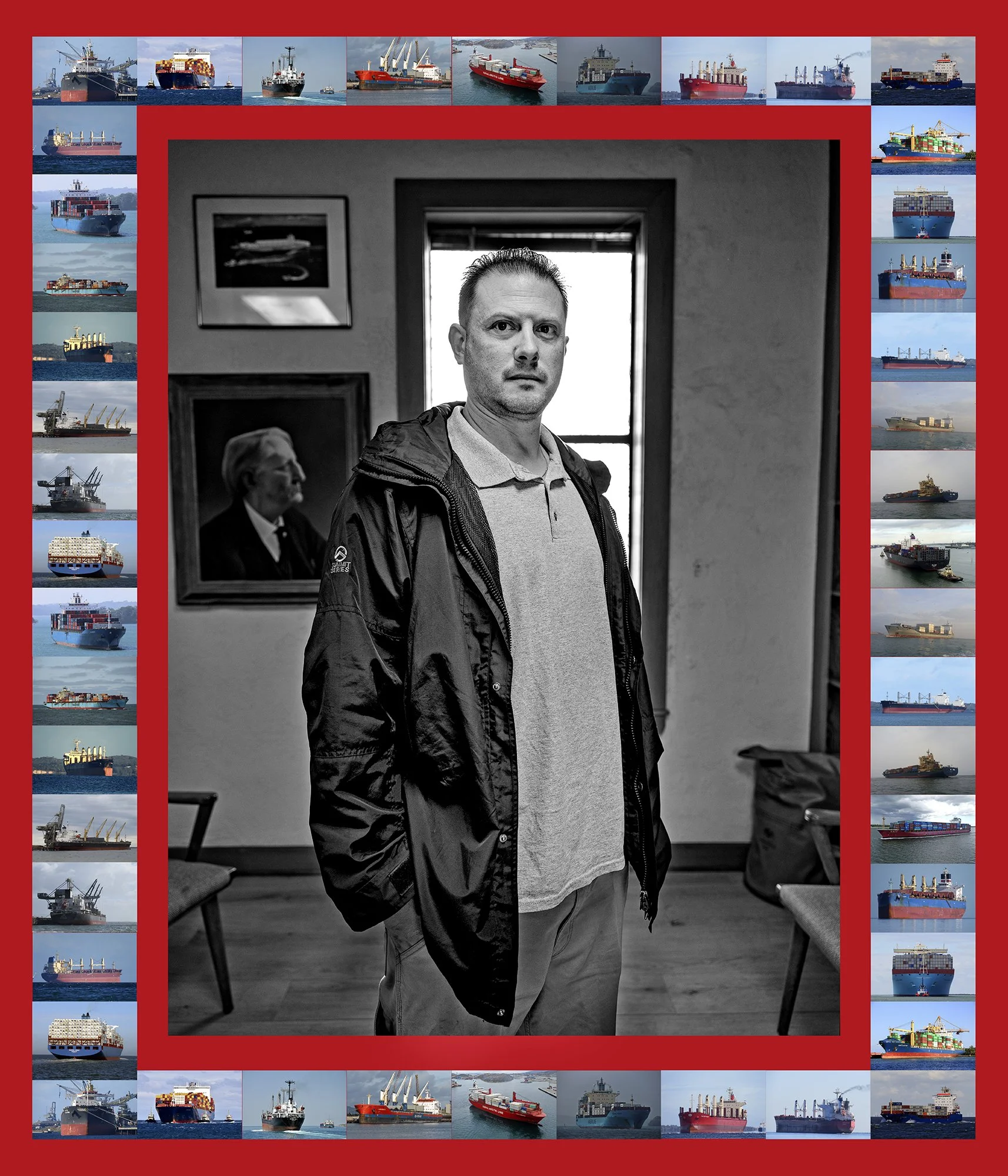
Beau Gouig, chief mate, unlicensed engineer, reefer engineer, junior engineer, Q MED - MM&P hiring hall, Oakland, California - 02 January 2026
“The things that I get to see out there, whether it's just nature, or stars, northern lights, and sunset. All those things are the most amazing part.”
“I mean, it's the most amazing job in the world, with the biggest downfall in the world, which is being away from your friends and family. I've navigated this, but of course just like any navigation, there's rocks and shoals and issues, that arise.”
My name is Beau Gouig and I sail anywhere from chief mate to unlicensed engineer, reefer engineer, junior engineer, Q MED (Qualified Member of the Engine Department).
I’m a member of two unions - Master Mates and Pilots (MM&P), and Marine Firemen Oilers Water Tenders Union (MFOW).
I sail on anything that sails the seas. Bulkers, car carriers, container ships, research ships, man-of-war, gray hulls [ships that are part of U.S. Maritime Administration (MARAD) or Military Sealift Command]. But no chemical oil tankers, I try to avoid those.
My favorite are the bulk carriers. You go real slow, so you get a lot of sea time. You get a lot of port time, and you go to different places that you might not go to on a container or liner run. They’re generally tramp ships.
Bulk carriers usually only go 12 to 14 knots, at max, because they have one solid cargo. Usually you're not in a hurry to get anywhere, and the companies rather save fuel.
A lot of sea time is good because that's when life is the best - when you're in a routine, and of course if there's no storms, and the weather is good. You can just get in a routine - you know the days can pass and you can get work done. We're more on our own, and life can be managed easier - as long as there's no issues or problems.
And port time is great, especially on a bulk carrier. You know, I've gone to Ecuador and you're there for six days at a time. I've gone to Bangladesh, you’re there for nine days at a time. You get time to explore and get off, rather than the 18 hours you might have on a container ship.
I have multiple favorite ports - Tonga, Pangaimotu Island - Hong Kong used to be my favorite, but now Singapore's kind of taken over that role. I've been all over South America, they're all good ports: Brazil, Chile, Central America, Costa Rica. I have multiple favorite ports for different reasons.
There’s no place I won’t go. I've been to third world countries. I've been in war zones. I've been to places where bombs are going off, Djibouti and Pakistan. If it's where they want me to go, I'll go.
..
I’ve been doing this since I was 19. I'm 44, so 25 years. It was fate. My dad used to bring me ship models, and I would build them as fast as I could.
I was always into ships, and my junior year in high school my dad mentioned that there was a maritime academy in Vallejo. I had to seek it out, my counselors didn't know anything about it. So, I applied and I got accepted.
Life kind of had some other things, so I didn't attend right off the bat. I worked with MFOW starting unlicensed, sailing wiper and junior and doing jobs. Then I went to the Academy and continued sailing with MFOW, working with them through the Academy. Got out, and been sailing for 25 years.
..
I've traversed more of the world than any person I've ever known. More than most sailors too, because I've chosen to work on the East Coast, work for different companies. And because of all the billets I can fill from any deck position down. I hold my master's license now, and any unlicensed engineer.
I've been able to visit, and sail in different parts of the world. The things that I get to see out there, whether it's just nature, or stars, northern lights, sunset, all those things are the most amazing part. I mean, it's the most amazing job in the world, with the biggest downfall in the world, being away from your friends and family. I've navigated this, but of course just like any navigation, there's rocks and shoals and issues that arise.
..
When I first started dating my wife, our first and second dates were 35 days apart. So, she knew right off the bat what I do. And that part, according to her, never seemed to be an issue.
The past few years I've only sailed five months a year to keep down and be home more, but, yeah, I'm going through a divorce right now. My two kids, that's all they've ever known, so I think they're fine. Technology, since they've been born, is amazing. I get to FaceTime them and talk to them on the phone. Ten years ago, I don't know how I would have done that.
Divorce is a part of our lives. You get on a ship, and there's 22 guys - probably two to three of them are happily still married. The rest have either never been married, never even had a serious relationship, or have been married multiple times. Or are going through a divorce. I know the odds aren't good back on land, but on a ship happily married is say two to three out of 24 to 25.
..
Sailors get institutionalized where you can't function in society, like say the U.S. It's ridiculous, there’s prejudice, and has all these rules. It's dirty, and you feel safer on the ship, more accepted and so people just want to go back to sea.
Just like a prisoner, if you've been living in a box for half your life you can't function in a big open world.
So, it depends on how long you're gone. This last time I was gone 126 days, so it's harder to adjust when I came back. Even yesterday I felt like I needed to get back on the ship, but that'll diminish. That'll go away for a while. Two, three months can pass. If I have a lot going on, I'll not want to go back to sea. But eventually Mother Ocean calls us, and there's something that makes you want to go back.
..
We don't sleep. But when you're on shore, you have a different rhythm. After you've been sailing for a while, a sailor's rhythm doesn't exist. It's completely broken. There's been lots of studies with all the time changes and stuff we go through. Our harmonic frequency and all that, our circadian (rhythm) becomes non-existent. It depends on if you're a watch-stander, if you're a day-man - your body, and your mind kind of adjusts.
This past time I was in the shipyard for a while, so I kind of got in that routine. And then I noticed the last 22 days of the ship I was a watch-stander, and anytime I was sitting, or in a relaxed mode, I could fall asleep. That was my body saying, okay, this is an available sleeping moment. So, I noticed that when I got home too, if I'm around, if I'm walking around doing anything, doing any type of chore, I'm wide awake. But anytime I put my body in a chair or at rest, I could instantly fall asleep. It varies. It varies ship to ship. Year to year our rhythms are broken.
..
You have to work with every race and religion on the ship as brothers. And sailors, I've found, are the most unprejudiced type people, because we travel all over the world. We experience all the cultures. We experience all these races and we come to this understanding.
When something happens, when there's danger on a ship, when there's an emergency, a fire, you're not looking to the guy next to you if he's black or white, you're looking to see if he has his fire gear on, and are we going to get out of this together? So all that bullshit disappears.
[And off the ship?] With your crew members that you might run into shore, absolutely, you’re your brothers for life.
But it doesn't disappear when you come back and see it in society. We have that ultimate view - being removed from society like a prisoner for months at a time. You get to observe, especially when you come back and you look around. You take on this observer role of how society is, how it’s working. And other cultures, you can compare what's right, what's wrong, what are they doing better?
Ships throughout all of history, all the way back to pirates and slave days, there's no race, there's no religion, there's only working together and surviving to do that, whatever it takes. Camaraderie on the ship is probably another reason why people still go back to sea. Even if they don't notice it, it's extremely apparent. It’s something some sailors can't get on shore, and it's why they keep going back to sea.
..
Beau Gouig, chief mate to junior engineer
…
Photo: Robert Gumpert
Transcription: Michele Colyer