Dylan Barnett, 2nd and 3rd mate (MM&P)
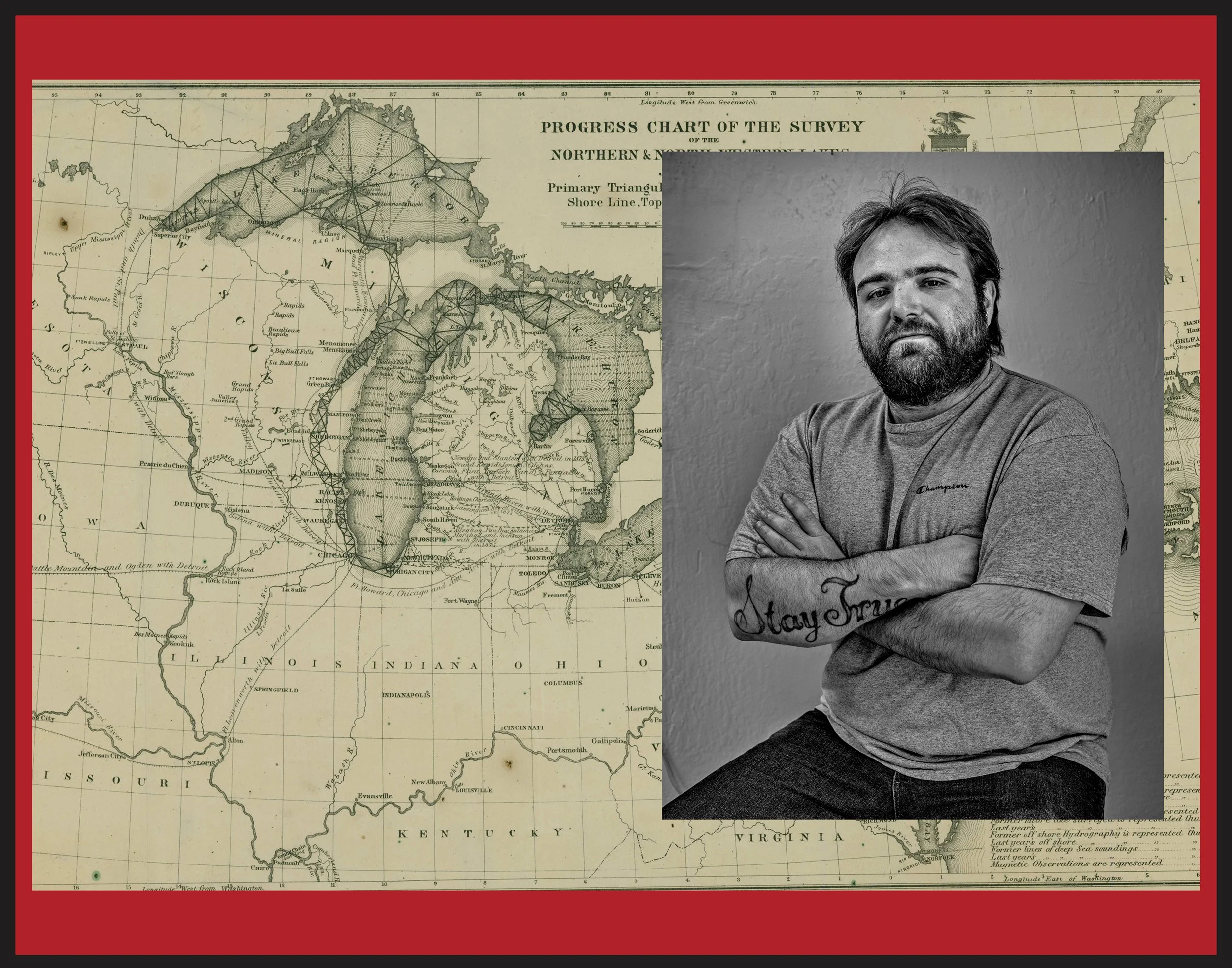
Dylan Barnett, sails as a 2nd or 3rd mate.
MM&P hiring hall, Oakland, California 14 November 2025
Shanghai. The Chinese, don't let the communism fool you. They might be communist, but only in name. They've been capitalists for over 2,000 years and old habits die hard. It's very transactional in China. They're very capitalist minded. In China you're not getting anything done unless you grease their hands, their wheels. They look for it, and they will make your job harder if you don’t.
I started sailing when I was 18 in the Navy. I'm 37 now, so damn near 20 years. After I got out I took my GI Bill and I went to the Great Lakes Maritime Academy.
I’ve tried the Great Lakes. I gave it the good old college try after the Academy, but it's cold. It's not really conducive to the lifestyle I'm looking to have anymore. The name of the game there is ship hard during the summer because the lakes freeze over in the winter, and the locks close. I would prefer my summers off. That's why I didn't stay in the Great Lakes.
Plus, there's more money to be made in the deep old sea. I mean the pay is comparable, third and second mate's pretty comparable. But once you get to chief mate and captain, it's them guys kind of get the shaft, if you ask me. They need to be paid a whole lot more than they're getting because they do a lot compared to others. We're all pilots on the Great Lakes because it's confined water, so we all have to have pilotage, from third mate up. But the captain, really he's the one that's doing it. The Great Lakes guys are real ship handlers, because there's very little tug work there. You're pulling a thousand footer yourself. So, in my opinion they should be paid a lot more than they are.
..
The Great Lakes is its own little entity. I mean, a lot of people, they've always said, at least in the ocean you can see a storm coming from miles away; especially with modern technology nothing really sneaks up on you.
But there's a saying in the Great Lakes, if the devil lives anywhere, he lives in the Great Lakes ‘cause you have beautiful weather one minute, and then two minutes later, a storm just come up where it's sheets of water coming, and you can't see three feet in front of you. It just comes out of nowhere. And it's because of the dichotomy between the warm lakes and the cold Canadian air coming over it that could just create a storm, just like that.
..
I've done everything from bulk carrying, containers, roros, the Man O' Wars and everything. The only thing I haven't sailed on is tankers. And you know what, everybody tells me I'm not missing anything. I just never found myself on a tanker ship. So that's the only thing I don't have much experience in.
..
Bulk carriers and box ships have different cargo. I mean everybody's kind of doing the same thing. We're all going from point A to point B, but it's different loading, different procedures.
(In the Lakes) it’s all bulk carrying there. They just make piles of ore, limestone, or coal at the steel mills to keep the furnace running through the winter.
Bulk, you have to pay attention when you're loading. Say you're at a chute dock - a chute dock is where they put coal down, and each one of them bulk carriers is 16 foot on center. So every 16 foot, you know you have a chute there. You listen to the loader, you got to do a lot more paying attention. When they put that chute down, if you're not doing your calculations right and they got more in there than you need to hold, you bury the chute. It's not like we just tell them to cut it off. No. Once that chute comes down, you own it. It's coming out whether you like it or not. And if you bury it, and you put more into it than you need to then everybody's not going to like it. The only way to get that [corrected] is everybody gets out there with a shovel, and we're going to put one in your hand too ‘cos you're gonna have to dig it out. So, in bulk carrier everybody buries one hatch. You'll learn not to forget it. It's a lesson. Put it like that, you won't make that mistake again, once you do it once.
But yeah, it's just dependent. If we're doing iron ore it looks like the holds are pretty much empty because it's so heavy. So, I have to really pay attention. I can't just fill it, you know what I mean? I have to really think what I put here. What’s in the fore of the ship? I have to do the same thing in the aft of the ship to try to even it out, but not put too much so I get a hog, or a sag in the middle. You gotta have your head in the game a lot more when loading and unloading bulk because of that.
Say they do an iron ore, it looks empty. But you're full because of your draft lines. It's the complete opposite with coal. I can fill those chutes, put mounds over everything, put it in every corner, and I'll never hit my low lines because coal is so light in comparison.
..
All the ships definitely handle differently. I mean, up in the Great Lakes they don't have bulbous bows, they’ve got the split bows. What they would call the whole concave bow - they're more rounded because we don't have to go as fast. Top speed on the Lakes is 12 knots. Out here in deep sea we're running 22, 23 knots sometimes, because time is everything.
I'm not gonna sit there and say they don't handle as well, but it's a little more easy. I was to put a fully loaded ore-ship going 12 knots, and I was to put it hard over, it's going to shake like hell. You're really going to feel it because it's like Newton's Second Law - an object in motion wants to stay in motion until acted upon equal and outside force. When you've got mass moving at that speed, and you try to correct it, you're definitely going to feel it in them old ships.
..
Belief it or not, my whole career I’ve been in the Lakes, the Gulf, the Atlantic, the Pacific, or the Indian. Just yesterday, November 8th, I come out of the Panama Canal into the Gulf. I went through the Windward Passage in between Hispaniola and Cuba, and then come out into the Atlantic for the first time, going up the shores of Bermuda and Florida until I finally got off yesterday in Brunswick, Georgia, and (now) I've flown back here. Yesterday was my first time I've ever been in the Atlantic.
Definitely the Windward Passage is aptly named, I will say that. It was blowing forty constantly there, but it was warm.
It’s different geography. You see different things. I was able to see Cuba, Hispaniola, and also Bermuda. It was nice. The Caribbean islands is different geography than I’m seeing. I mostly sail the South China Sea, Singapore, Straits of Malacca. Indonesia. They're islands, but they don't look the same. They're very more built up, too. You can definitely see when you're going through Malacca, you can definitely tell what side's Singapore, what side's Malaysia. Singapore looks like a modern spaceship. And then you look over, it still looks like jungle, untamed jungle in Malaysia. So, yeah, it's different. I like it.
..
Since I've got out of the Navy I like to have my time off. That's what I really like about this industry and especially being in this union, I get to choose a little more of when I go to work and when I don't. And that means a lot to me. When I was in the service I didn't have a choice, I just had to deal with it. I learned what I want in my life, and having more control when I go out and when I don’t is definitely what I wanted. So I usually sail anywhere from 120 to 150 days a year, and I try not to do more than 60 and 90 at a time. And I've been able to stay true with that.
..
When I was in the Navy I would say my favorite port was Laem Chabang, Thailand. Very fun. Cheap. Wonderful, and not too far from Pattaya Beach. And yeah, it's a modern city and Americans are loved there. And you see all different types of cultures and everything. You know our dollar goes far and we're greatly appreciated, and the feeling's mutual. I really loved that when I was in the Navy.
Now, here in the Merchant Marines, so far, I love Honolulu.
Honolulu's a great little port to hit. It's like a second home to me I hit that so often. We usually have to do a full on-load or offload, so we usually get anywhere from 42 to 48 hours every time. So yeah, the fun and the sun. Always constantly beautiful, and everything's so close together. It's definitely a sailor's paradise, Honolulu.
And it's America, you know, still considered American. Don't have to go through customs, or port, and all that stuff but you still get that feel. You know what I mean? Yeah, just like Guam. Guam's another one. It's American territory, but it's like Hawaii. It's like a cheap Hawaii, but without the waves.
The worst port I've ever hit is, I would have to say Lazaro Cardenas, Mexico. Yeah. It's supposed to be their biggest port in Mexico, but not a lot going on. It's old, it's run down, and it's very money oriented, from the longshoremen and everything else.
Number two would be Shanghai. Shanghai, it’s the same way. The Chinese, don't let the communism fool you. They might be communist, but only in name. They've been capitalists for over 2,000 years and old habits die hard. You try to get things done, like as a deck officer, and they say, “We can't take this container off because this compressor's not fitted on there properly.” And I'm like, “What the hell do you want me to do? Get the bows in and you take it off. I'm not taking that heavy thing off. We'll tie it on there to secure it.” They're like, “No, no, no, don't work, don't work.” And then I give them two packs of cigarettes. Okay, okay, okay. Now it works. Now it's okay. It's very transactional in China. Very transactional. They're very capitalist minded. Actually I'll go so far as to say even as bad and run down as Azaro Cardenas was, the attitudes in China are you're not getting anything done unless you grease their hands, their wheels. They look for it. And you know they will make your job harder if you don’t.
..
What I used to like about being on the water - it's getting harder now. We were in our own little world. I loved the ability to disconnect. But now with the internet and everything it’s changed a lot. We're constantly in contact with the company. Constantly in contact with family members. Which is good, but there were times I loved it. You know what I mean? “Oh can't deal with that right now. I'm away. But don't worry about it.” ‘Cause I've always was of the feeling absence makes the heart grow fonder. You gotta go away in order to be missed. So with this modern technology nowadays, it's hard to go away sometimes.
That was what I really enjoyed about sailing, I'm somewhere new, or somewhere I haven't been befor. It's constantly changing, and I don't feel like I'm stuck in a rut.
The thing that scared me the most, my grandfather he worked in Bell & Gossett, a Chicago pump manufacturer. He didn't have a formal education. Didn't have a high school diploma. But he ended up head of the drafting department, the highest position somebody can have without a degree.
Even for him that's what it ended up as. He went to drafting school at night to get to where he was at. But he walked in, and out of the same building for 42 years. And that scares me. I wouldn't want to walk in and out of the same place for 42 years, unless it's my home. You know what I mean?
I'm different in that sense than my grandfather. I would feel confined and cooped up if I just worked in one place, in the same office. I do not want to do that. I want to go around.
That's why I like being out because it’s constantly changing. Everything around me, the weather, all that stuff. You got to be on your toes. Nothing's for sure. You gotta pay attention, and you know you can't just put it in autopilot. It makes me stay grounded in reality - in my opinion. I don't just go off into “Lala land”. I have to be present and I enjoy it like that.
..
I can say I feel an attachment to the sea. I'm originally from Memphis, Tennessee. I started working on the tow boats when I was 16. And then when I finally became 18, I told myself I wanted to join a real ship.
I joined the Navy and I ended up - it was the height of the Iraq War - having to do a tour over there.
I knew I was going to work on the water somehow, some way. I knew that was going to be my lifestyle. Not even just to work, but to live. Like, I can't not be next to a body of water. It just seems right. So yeah, there's definitely an attachment there.
..
There's a thing we always say when we're getting off - like the other day when I was getting off the vessel - I didn't sleep the last two days because of what we call “channel fever”. You're getting excited. You're starting to think what you're going to do when you get back home.
And it's vice versa, too. You get home, you sit down for a while. Whatever relationship you're in, with your woman, your kids, stuff like that, you get to the point you're like, oh my God, I can't stand looking at these people anymore.
I think it is the best job because anybody can get tired of anybody when you're around somebody so long. But when you do that 60 days, or 90 days away 90 days back, it's a nice reset for both parties, if you ask me.
..
I equate getting off the boat to getting out of jail. But you know you don't usually have a pocket full of money when you walk out of jail. You get freedom. That's a sense that you get that I can't explain to anybody else. I get that two, three times a year. It's like I've done a job. I'm getting off, I have this much time off, and I have this much money in my pocket. It's just a sense of longing and freedom that I know not many other people have.
In America usually everybody works their 40 hours a week and looks forward to the weekend. You know, work five to get two. That felt bad odds to me. Here I work 120, 130 days a year and I get a full year salary. So I work four, four and a half, five months a year, and I get a full year's salary. The world is my oyster after that. Like okay, I'm going to go piss off and stay in Brazil for the next two months. Nobody else, unless you're in this industry, or doing something like contract work, can do that.
I enjoy that. I enjoy the freedom and what it affords you. And that's my biggest thing, when you're at work, you're at work. But when I'm at home, I would argue I have more freedom than most. I don’t feel I’m tied to my job. I'm of the sense of I work to live, I don't live to work.
And that's what I love about working on the water, because it affords me that mindset and mentality.
..
Dylan Barnett, Second Mate - MM&P Hiring Hall
…
Photo: Robert Gumpert 24 November 2025
Transcription: Michele Colyer