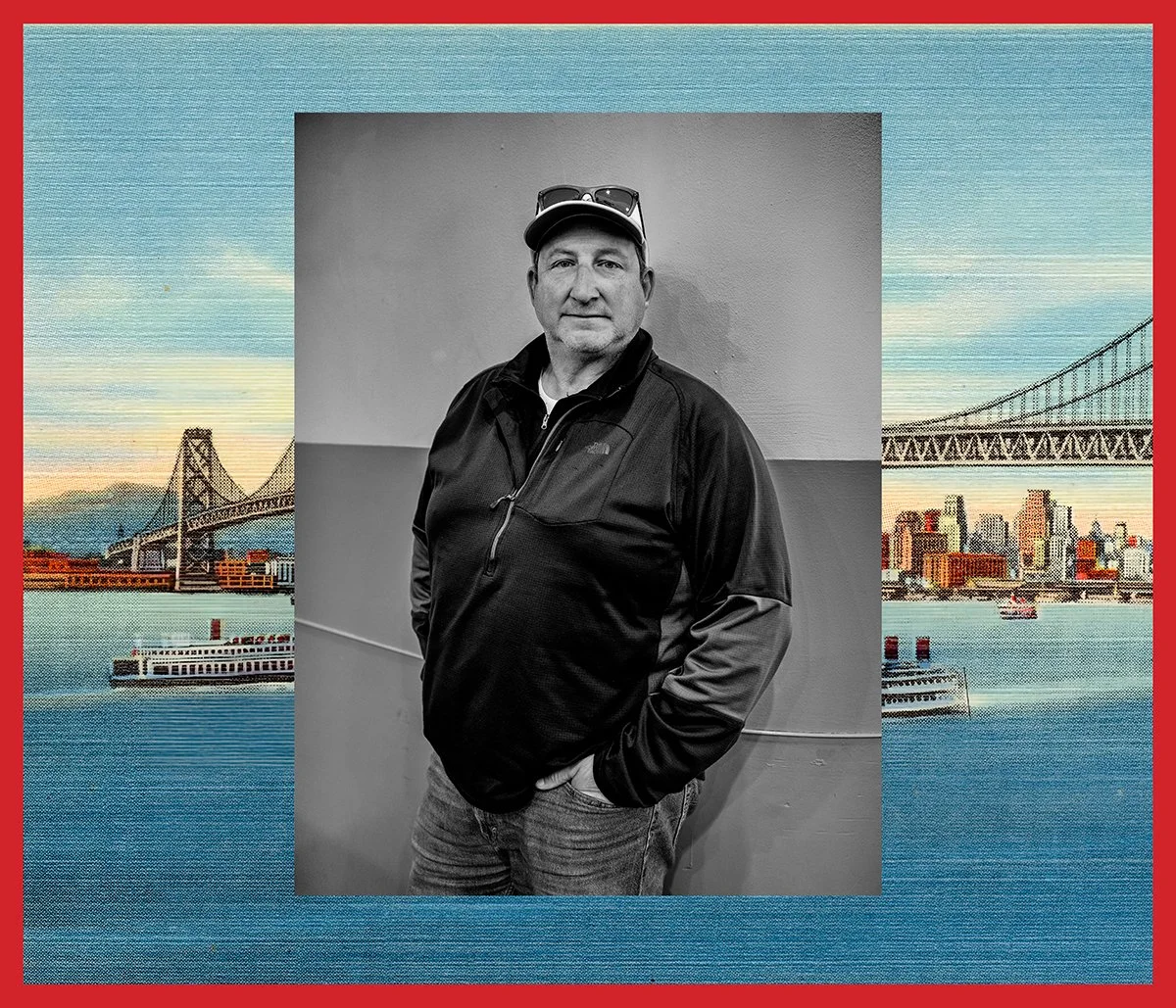
Peter Gualfetti, Inland Boatman’s Union (IBT), deckhand and boat delivery skipper. IBU hiring hall. San Francisco, California 24 June, 2026
People who actually use their boats, sailboats particularly, as ways to get anywhere on the planet is a pretty small group. So when you spend enough time in that area, you get to know a lot of them.
I figured (as a member of the IBU) if I didn't really go out the (Golden) Gate, I wouldn't be tempted to go any further, so I could make it work from there.
[But] every day I miss being out in the blue. There's a different experience when you are a thousand miles offshore. I describe it to people as sort of like space travel.
I've been working on the water since 2012, but with the Inland Boatman’s Union (IBU) as a deckhand only since March of 2026.
I showed up in San Francisco in 1999 with the desire to learn how to sail. I had been on power boats in New Jersey growing up, and so I just went down to a yacht club for a “beer can” race. You put on a label that says, “I want a crew”, and you look for somebody’s that says, “I need crew”. Then you go out on their boat, and that's how I started.
..
I lived on a a catamaran from 2012 to 2014, and the catamaran - I was not on it - got struck by lightning. It took four months to get the parts in and repair it.
As I was sitting around I knew a lot of people there who I had met cruising over the years, and they asked me to deliver boats.
I started with three day trips to like Portobello. Then week-long trips to the Bahamas from Panama, and to Caicos, or anywhere.
Once it was ready I got my boat through the (Panama) Canal and delivered it up here to Napa.
A lot of “cruisers” are retired in their 60s, 70s, 80s, in some cases. At the time, I was in my 40s, and so if they were looking for help they would just call me up.
It was all word of mouth, and independent contracts - I can get your boat from A to B. I'm going to charge you this much. And they pay you half at the front, and half when you get the boat there.
You can organize flights, depending on what you're doing, to or from the boat. All of that is in an independent contract per event. And that's it.
..
[Now] the family situation has changed to where it's advantageous for me and my family that at the end of the day I come home from work as opposed to I'll see you in eight weeks - I'm heading to Nicaragua.
I figured (as a member of the IBU) if I didn't really go out the (Golden) Gate, I wouldn't be tempted to go any further, so I could make it work from there.
But every day I miss being out in the blue. There's a different experience when you are a thousand miles offshore. I describe it to people as sort of like space travel.
Usually I would do these trips with myself and two other crew members because three people fit in almost any boat. And if they were ex-racers we could work around the clock easily.
That's your whole reality. You can only see about 10 miles because of the curvature of the earth. And so when you're out there, you don't see anything. You don't see ships. You don't see planes. You don't see sea life. Nothing of humanity other than the people on board with you. And so you get more in tune with nature again.
The sun comes up and goes down. If you're heading in the same direction, always the same way at the same time. Water, color, temperature, things change. You get more in touch with that.
And I think stripping away all of the comforts that we've built for ourselves in modern society is good to do periodically. Or as much as possible, depending on how you look at it.
..
[Working on the ferries] is a different experience in some ways. But the water is the same. When I raced on the bay, you don't get between the south tower of the Golden Gate Bridge and land, whether you're in a 22-foot sailboat or in a 100-ton ferry. The way the tide makes the waves work under the Gate, and when the wind comes up and shuts off with the fog in the bay area, all that's the same regardless of vessel.
..
I have lived in San Francisco when I wasn't delivering boats since ’99, and I'm very passionate about the city. And particularly during COVID, I felt like all cities, but specifically San Francisco, needed something for it to be happy about, bring tourism back and get things sort of back to normal.
I find that sharing some of my knowledge on these short cruises with people is actually quite fun.
Loading and unloading is all about safety - watch your step on the ramp, etc. But once you're on board - if you're out there for even just 10 minutes going to Alcatraz, or an hour going to the ballpark from Larkspur, or just underneath the bridge and around, people are generally interested and engaged. They're interesting people to talk to, and I feel I can put the water, San Francisco Bay, and the city itself in a good light because I've been here for long enough to feel local.
The public isn't all perfect. There are plenty of people who have too much of the Giants game and make a mess. You have to pay attention to that, but I have been a bouncer in a previous part of my life, so that's not all that hard to do. It's more about keeping them safe for themselves. Like maybe you should just sit down instead of standing at the rail.
But a lot of times it's just me taking photographs so that people don't drop their phones in the sea. They're leaning out for a selfie and I'm like let me take that for you. My photographs are terrible, but they're better than losing the phone.
..
I still get calls and emails wondering, for instance, can you get my boat from Sweden through Scotland and the locks to Ireland. That would have been very cool, but I had to pass on that one.
So yeah, there are certainly lots of opportunities that come up. It's a pretty small community of people who go long distances on boats. Most people have a boat like a floating condo so that they can leave their warm inland house and go down to the cool water. Maybe they drive it. Even if it's a sailboat they don't take the sails out. They go across from Richmond to Tiburon. They go to Sam's and have brunch, and then they drive it back.
People who actually use their boats, sailboats particularly, as ways to get anywhere on the planet is a pretty small group. So when you spend enough time in that area, you get to know a lot of them.
..
I've been on a lot of different boats. If I'm going into blue water, monohulls are better than catamarans. Catamarans are great for getting closer to the beach than everybody else because they don't draft a lot, and they have a lot of space because you have two hulls. But catamarans are more stable upside down than right side up because they don't heel. They flip, or the mast snaps off if you don't take care for too much wind.
Where with a monohull, if you get too much wind, the boat falls on its side, the wind spills over the sail, and then you've got a 10,000-pound keel to contend with, and so it kind of bounces back up. It's not comfortable while it's doing that, but you can get the canvas down and then deal with what's next. For long distances monohulls are better.
..
I come into the (hiring) hall every day that I'm able. I'm doing day work. Sometimes I get a 24-hour segment or something like that, like a three-day baseball run, or whatever. I'm not opposed to longer times, but because I'm new, I have a D card, which is the lowest level.
Once a month, you're at the bottom of the list when you re-register. Then over the month, you become higher to the top, so you have a better pick of jobs periodically through the month.
For a D card you register once a month. For a C, B, and A card, you register once every three months. If you pick up a job that's more than 40 hours or 80 hours, and I forget what it is, like if somebody's on vacation or sick relief, then they tear your card up, and you have to re-register. You go back to the bottom of your pile. So either time bound or job bound, you go back to the bottom of your list within your particular segment.
..
Peter Gualfetti, IBT, deckhand and boat delivery sailor
..
Photo: Robert Gumpert
…