Captain Nicholas Killinger Master, Mates, and Pilots (MM&P)
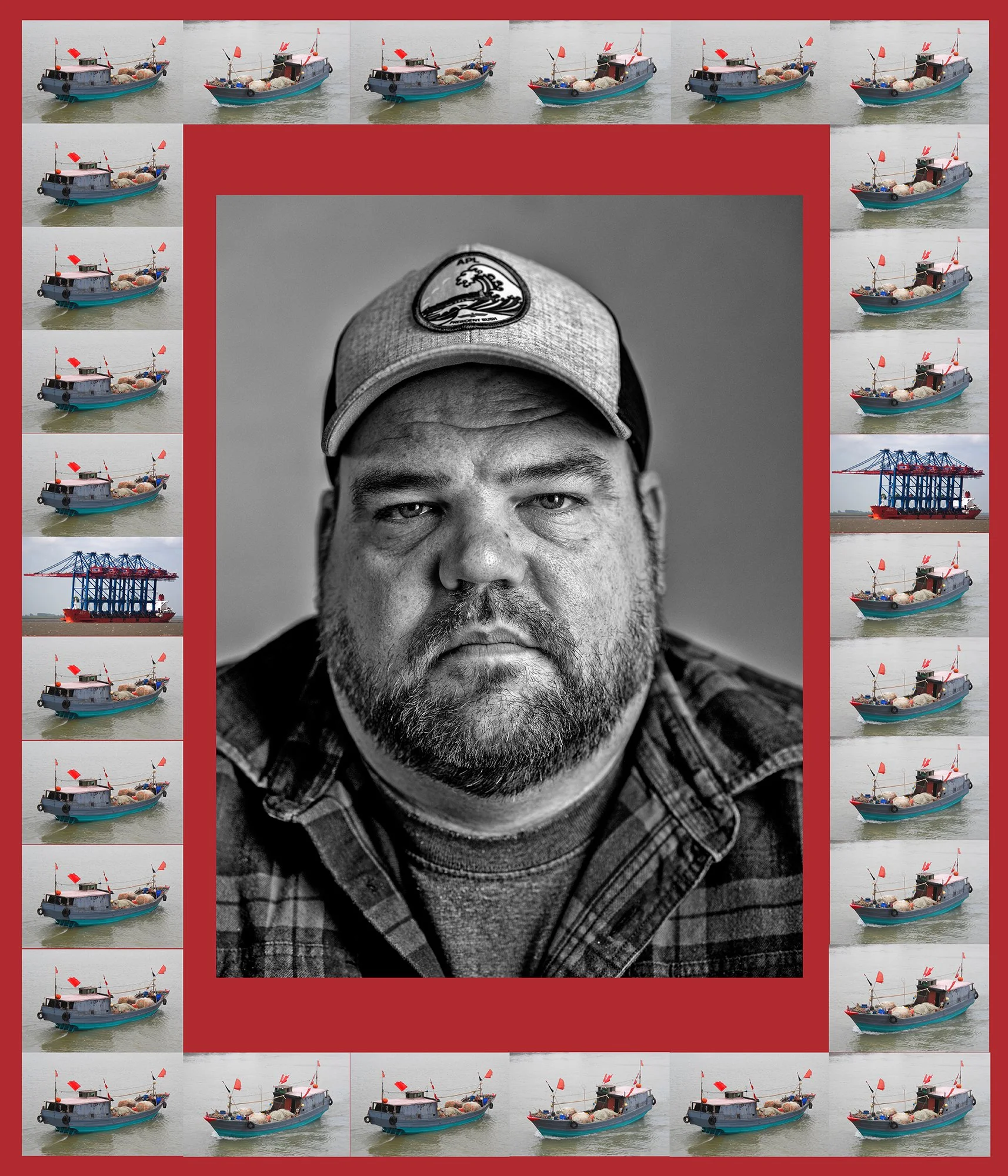
Captain Nicholas Killinger MM&P hiring hall, Oakland, California. 09 December, 2025
“One time on a heavy lift ship I was a chief mate on we picked up two 120-ton Coast Guard cutters, put them on our back deck, and brought them over to Ukraine. It was fun making the rigging - calculating the rigging, calculating the stresses, calculating the move. You know, picking something up with the crane, even though that part's the easy part.
Once it's in the air, the worst case scenario is the line parts and everything goes haywire, but there's nothing you can do about that if the wire parts. So, doing that part was the most fun to me.”
I grew up in Maine where there's the Maine Maritime Academy. When I was in high school my football coach and a couple kids I knew were going there, and they said I needed to go check it out. So I went up.
The selling point for Maine Maritime was it was inexpensive at the time, and they tell you you're going to make six figures, and get six months off. I was like, that's awesome.
My dad was in the Coast Guard for a little bit, so it was always an interest, and I decided to go up to Maine Maritime. I've been doing it ever since.
..
It took five years to get my license, but I sailed extremely hard. I sailed a lot when I was younger. To sail captain, it took me 15 years.
When you get out of school, you get a third mate's license, a Third Mate Unlimited [qualified for a vessel of any size or tonnage, anywhere in the world].
Then you need 360 days of sea time to get your second mate's license. Then another 360 days of sea time to get your chief mate's license, and a bunch of classes. And [there’s] an exam to take between second mate and chief mate.
After your chief mate’s license you need 360 days of chief mate time, and then you can get your captain's license. Or, you need 180 days of chief mate time and 360 days of second mate time.
But just because you have the (captain’s) license doesn't mean you're ready to sail on it.
..
Forthe most part, if you start your career with MMP and you join the union right away, by the time you become a chief mate you have your “A” book, and you can become permanent, then that company promotes you to captain.
You become what they call a relief captain. You go from ship to ship to ship, but the company chooses what ships you go to. That's what I'm in right now, I go from ship to ship to ship. I do a run here or two runs there. Once somebody retires, or there's an opening, then I can become a permanent.
..
I was actually on a ship when COVID started. I joined the union later in my career, it was 2019. My first ship was a car carrier, and our first foreign port was Livorno, Italy. As we left Livorno, Italy closed down.
We went through the Suez Canal and into the Middle East, and as we were going things were closing down.
Once we were on our way back it was kind of funny. All the news articles, and everything we were getting, it seemed like the U.S. was like this giant war zone.
Our first port into the U.S. was Jacksonville. We pulled into Jacksonville and I've never seen that beach more packed in my entire life, people were just enjoying life.
After that, all the regulations came in, the testing, the quarantining. So for the majority we would test before we left our homes. We would fly to the port, stay in a hotel for five days and quarantine, and test again. Then we would have a quarantine driver drive us to the ship, get us on the ship.
Some companies quarantined you in your room, some didn't. It all depended on what each individual company came up with for a COVID policy.
I didn't go to the Far East during that time, my trips were majority in the Middle East, and Europe. The Middle East everybody wore masks. I was [mostly] on car carriers at that point, so the majority of the people coming on and off to drive the cars, we would stand away from them, stuff like that.
The only really interesting thing about COVID was I got off in Germany. I crew change and they drove me to the hotel because I was flying out the next day. When I got to the hotel they had to call the police station to tell them I was there.
Then I got instructions that if my plane got delayed or canceled I had to call down to the front desk, and they had to inform the police department. I couldn't leave my room, they would bring everything to me. Luckily, I got up the next morning, my flight was on time, and I flew home.
..
I love the Mediterranean. Being from Maine I've spent the majority of my career over there.
In the Middle East nothing's on time. Everything's delayed. Everything's late. They'll tell you one time, and you can expect to be four hours delayed, minimum.
Come to the West Coast, Japan tells you (the) pilot’s going to be on at say, 10 o’clock, (and) that pilot's coming on at 9.30. “Last line” [final line securing the ship to the dock] is 10 o'clock. Same thing in Korea. They are very punctual - same thing in China. So it's a little different how they operate.
But as far as my favorite place, the Mediterranean. The whole thing's beautiful - Italy is beautiful.
Spain's kind of funny because they have siesta. If you're doing cargo and siesta happens, all cargo is shutting down. They're going to take their nap, and they will be back.
I worked in Romania for two years on a tanker. That was great. I loved it over there. It was before, of course, all the war and everything. But, yeah, I mean, it's just different.
Mumbai, India would be my least favorite port. That or Pipavav, India, one of those two.
Getting into Mumbai is a pain. Pipavav [India's first private sector port], you have a swell that comes through during monsoon season and it's a nightmare doing cargo. All you're doing is running around tightening lines the whole time so you don't part (snap) them.
Fishermen, fishing boats are a problem in China, Korea, Japan, all around the world.
When you go into India, like if you go to Pipavav, and into that little coast on the west side of India, you just stand up in the window, find a little black hole [between all the fishing boats], go for the black hole. If they try to get in there you honk your horn. They don't get out of the way - move, find another little black hole. You do that for eight hours.
They're a nuisance everywhere. You've got two guys working on the boat, they're not in the wheelhouse. They're out trying to get their net in so they're not even paying attention, and you're coming through. I mean, it's the same thing in the Gulf of Mexico. Off our coast, you have the shrimpers.
..
My opinion with autonomous shipping is the problem isn't going to be the ships themselves, it's going to be all of the stuff that you can't factor. You can't factor fishing boats to an autonomous ship. They're going to run it over.
You’d have to setup highways, (I think) where fishing boats can't get into, and the ship has to go that way. But then you'd have to build them more robust because they're going to be taking weather because you have to go that way.
..
For the past two years work’s been majority over to Asia and back. Before that it was strictly East Coast. On the East Coast you have, think of a typical New Yorker, you know, high strung. Usually, you have more of that over on the East Coast.
On the West Coast you have more of a relaxed vibe, give or take. I mean, sometimes you get a guy from the West Coast that goes over the East Coast, and sometimes you get an East Coast guy like me that comes over here. So, usually it's a more relaxed vibe over on the West Coast compared to the East Coast.
..
The two most important positions on the ship would depend. For morale, the steward’s department is the most important. If the steward’s department …, if they suck morale goes down.
Operational-wise, it's usually the chief mate and the first assistant. They're kind of the “do-alls” of the ship.
The first assistant is in charge of the engine room and everything that goes on down there for maintenance. He talks with the chief engineer to get everything planned and done - all of that.
The chief mate is the one that runs the deck department, runs all cargo operations.
So, they're kind of the two workhorses of the ship. I would say operation-wise those two. Morale-wise, the stewards department.
As a whole, in my opinion, the most important part of a ship is actually keeping the ship clean, the OS [ordinary seaman] helping clean the ship. It was something that was drilled into us when I was at Maine Maritime, and it stuck with me. So I'm sure you'll get a hundred different answers, but those are the most important to me.
..
Stress depends on your position, and it depends on the individual. Stress is what you put on yourself, and what you allow others to put on you. So, especially when you're a chief mate or a first, you can feel like the world's coming down on you all the time because you're responsible for all of this.
Now, the captain's responsible for the entire ship, but by the time you make captain you should be able to delegate, and know how to manage the people. That's what you're doing, you’re managing. You're the CEO of a company. You have hundreds of millions of dollars of cargo, and up to 25 people’s lives in your hands. So you're really getting paid to make a decision, and to trust the people below you.
Third mate you're in charge of safety and life-saving equipment - you’re walking around doing inspections and stuff, and you tell any problems to the chief mate.
Second mate, you're doing charts and navigation. You're talking with the captain about where we're going to go, how we're going to do this, stuff like that.
When you get to chief mate you haven't really had too much management, and then you have the whole department on you. And you have all this cargo. It's easy to forget that you have other people that you can delegate stuff to.
It took me a little bit to figure it out. But once I figured out that I have all these people to do what I need to get done, then the stress started coming off.
..
My favorite kind of ship would be heavy lift. I've done pretty much everything - tankers, bulk carriers, heavy lift, car ships, dp (dynamic positioning) vessels, and container ships. My favorite is the heavy lift, it’s the most dynamic.
One time on a heavy lift ship I was a chief mate on we picked up two 120-ton Coast Guard cutters, put them on our back deck, and brought them over to Ukraine. It was fun making the rigging - calculating the rigging, calculating the stresses, calculating the move. You know, picking something up with the crane, even though that part's the easy part.
Once it's in the air, the worst case scenario is the line parts and everything goes haywire, but there's nothing you can do about that if the wire parts. So, doing that part was the most fun to me.
..
When I was younger I always wanted to be at sea. I didn't care if I was home or not because I had nothing to be home for. Now that I have a family, it's turned into more of a job, and I can't wait to get home.
I worked land-side for two years and I did what everybody else in the world does. I got up at eight or seven, made it to work, came home, picked up the kids, get the kids in the shower, fed them. We put them to bed, and then again the next day. I hated that.
I enjoy being out there. I enjoy being with the guys. I enjoy what we do, but it's more for my life at home because when I go home I have three months off. I have no job. I get to go to basketball games. I get to be a football coach. I get to go to school, and do volunteer work.
I love the fact that I get to be home and I get to be with them. I can pull them out of school and go do something for a day.
So, the love of the sea and all that stuff has kind of gone away, but this affords me to be able to do things that I really love to do.
..
Captain Nicholas Killinger, Master, Mates, and Pilots (MM&P) Oakland hiring hall. Oakland, California
..
Photo: Robert Gumpert
Transcription: Michele Colyer
…