Paul Fuentes, AB retired (SUP)
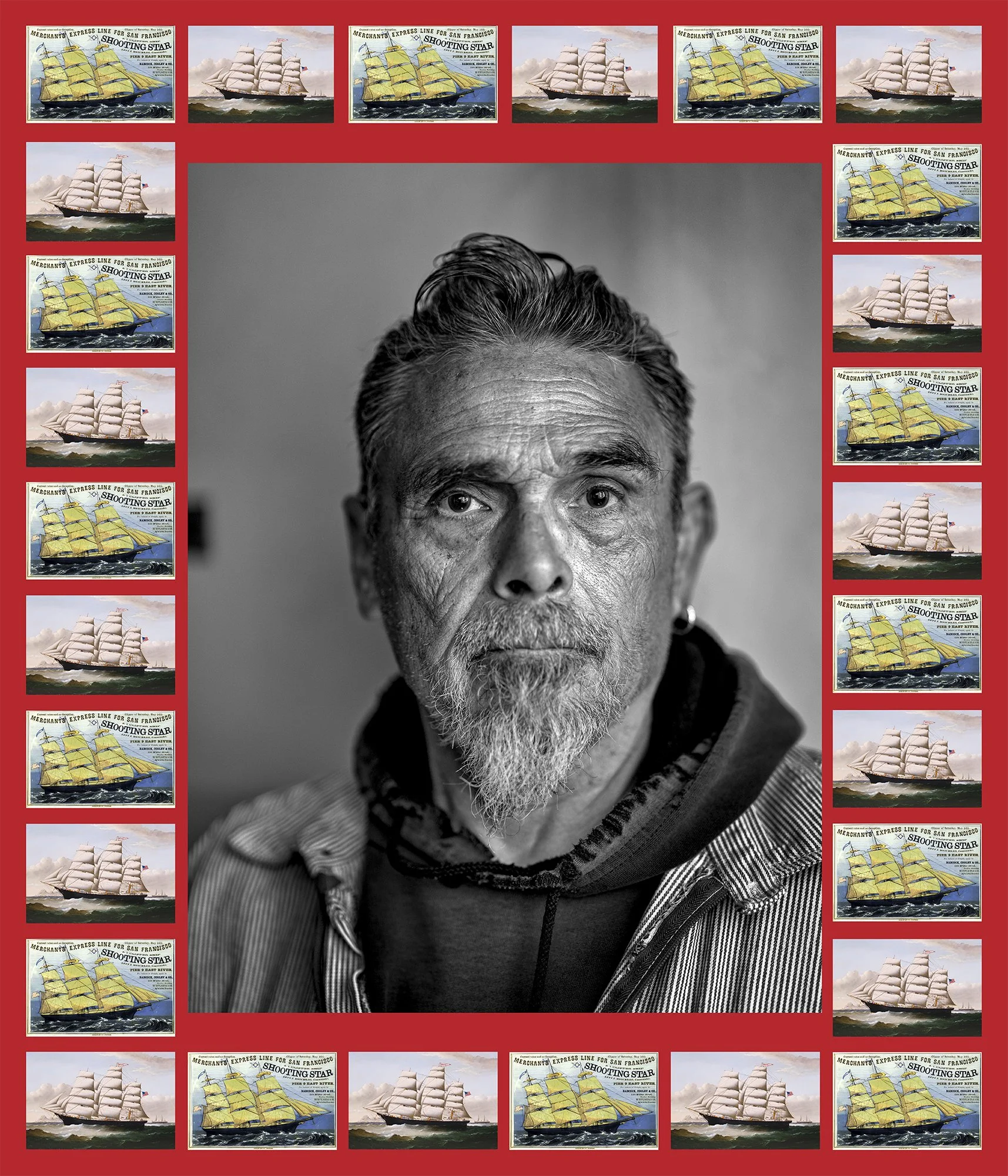
Paul Fuentes, AB. Member of the Sailors’ Union of the Pacific (SUP). SUP hiring hall, San Francisco, California
“Back in the 50s when the hall was still a new building, this was like a little city amongst itself. You had [besides the hiring hall], a bar, restaurant, library, and an auditorium for entertainment.
You had all kinds of offices and on, I forget if it was Fridays or Saturdays, they would hire out the hall for a dance.
That's where my parents met.”
I sailed for just under 50 years working both on deck and in the engine room. I worked in the stewards department for three days, and that was it, no more than that.
..
When I first learned about Bloody Thursday it really wakened me up as to the labor movement.
I believe we were staying with my grandparents, which was not too far from here [the SUP hall], and during dinner I spoke about it with my grandfather. He said when he was a miner back in Colorado they had a big strike. The strikers had their families living in a tent city, and that tent city was the strike perimeter.
One day the owners of the mines hired some people with guns and they came along and slaughtered the families and the mine workers.
That really awakened me. You know I thought Bloody Thursday was something, and here he comes telling me that's even worse because on our Bloody Thursday it was the workers that were shot and killed. But for the miners their families, their kids, their wives, they were killed, which is really unacceptable.
I learned a lot about the labor movement from my grandfather.
..
The [SUP hiring] hall means for me personally, the beginning of my life.
Back in the 50s when the hall was still a new building, this was like a little city amongst itself. You had [besides the hiring hall], a bar, restaurant, library, and an auditorium for entertainment.
You had all kinds of offices and on, I forget if it was Fridays or Saturdays, they would hire out the hall for a dance.
That's where my parents met.
My dad was in the army, he was just getting out. My mom was getting ready to get out of high school. They met, and next thing you know here I am.
So the hall REALLY means a lot to me.
..
After I got out of the Marine Corps I kind of wandered around. I didn't really know what I was going to do.
Jobs were plentiful, but you needed training. You needed experience I didn't really have. Nobody's looking for a combat photographer, you know.
I started getting in trouble, and finally my mom figured he's either got to shape up, or ship out.
My uncle was a member of the union [SUP]. However, he never went to sea. The way he was a member is he grew up with a lot of the members, but became a dentist and did a lot of the dental work for the union.
They would send people over to him - he did the work, and the union would pay him. He was really good so that's how he became a member of the union. And my mom was his dental assistant.
With me getting in so much trouble my mom talked to this unit rep that was a patient of my uncle's - could he get this kid [her son] a ship or something? Get him out of here.
He said, yeah, I'll get him in. Back then it was a little easier, all you had to do was get an application to the Coast Guard, get your papers, and then come to the union, and pay [dues]. Do that, and get on a ship.
It was more or less what I wanted. You know growing up living in San Francisco, a shoreside city, a lot of us knew about going to sea. We knew all the stories. We knew kids whose parents, or fathers, were on ships that were in the Navy Yard.
So there I was, and I stayed ever since.
..
(My first ship) was the oil tanker, the Lion of California, one of the hardest working ships in the fleet.
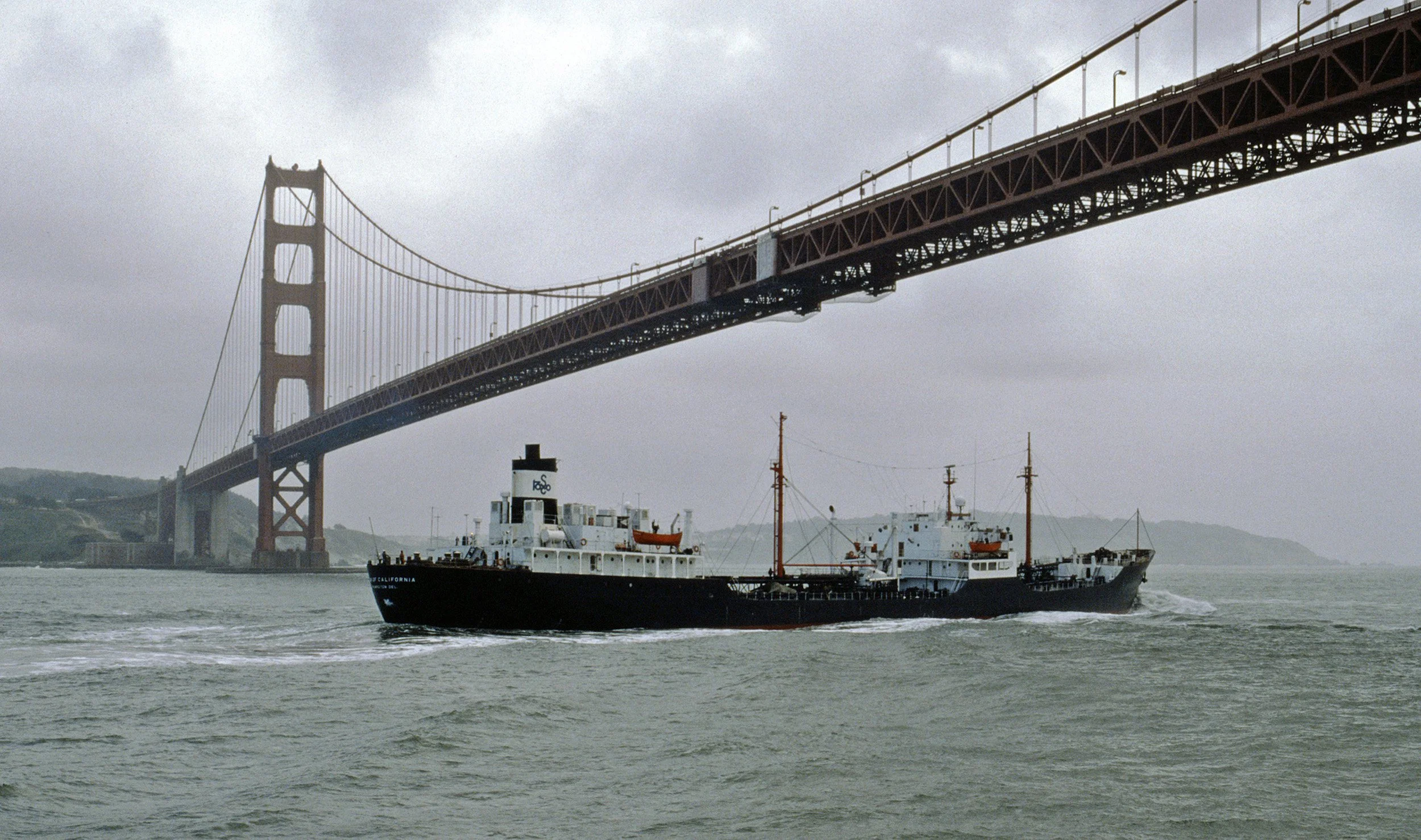
The tanker Lion of California heading out to sea under the Golden Gate Bridge. 1987 in San Francisco. Photo: Wiki Commons.
On just about every ship in our fleet you do 30 days and you're eligible for vacation pay. Once you do that you can quit any time. But one of the things on the Lion of California, you had to do your whole time, 90 days, before you're eligible. And the captain, he had a way of getting rid of people before that 90 days.
He didn't get rid of everybody. He didn't get rid of me. But a lot of people had quit or got fired before that, and that's why it wasn't a very likable job. The money was good. I was able to get away from the streets for a little bit. Kind of clean up, sober up, and say this is what I need to do.
After I got off I was able to go ahead and just let loose. I had money in my pocket. (I could) pay bills, go on a drunk, or do whatever I needed to do. Then turn around, come back to the hall and get ready to get on another one.
With my seniority tankers was pretty much all I could get. I mean I was able to get a freighter here and there, but I knew once I got my seniority I would be able to get on freighters more often.
It was like instead of going to jail, why don't I get on a tanker, do my time, make some money, and then I got something to look forward to.
Then I started getting serious about settling down and having a family. I had to focus on taking care of them even though I would stray, and the alcohol would get the best of me.
..
It's definitely an institution. When you're in the deck department, or the engine department, you're going to have nothing to do with going into the galley to do anything except maybe the deck department doing the groceries every so often.
But you're never really like at home [where] I get in there and I help the wife here and there. But on a ship I don’t. Not even little. (It’s the stewards’) section of the vessel, and you don't touch it unless you're asked. So, yeah, it's pretty much institutionalizing.
..
(I’ve been retired) about a year now. I do miss being able to go to work. The work part I don't miss at all. The travel part, yeah. Or even a little vacation from the wife.
(Before) there I was, you know, gone for a while. Then I'd come home, and we'd start getting tired of each other. Okay, I gotta go.
Now it's like, well, where am I gonna go? So I have to, we have to, deal with each other, which is fine. It's a learning process for both of us.
..
Sometimes (I miss the ocean). Nowadays, though, when I look at the news, I see the results of global warming, and all the major storms going on, I pretty much thank God that he allowed me to be able to retire and rest on solid ground.
..
One of the things I used to like, you know, is when we would be going to say Hawaii, a nice, calm place like that. The weather's nice, and you go out on lookout up on the bow. You got about an hour all to yourself under the stars, and the weather's nice and you're just out there.
I mean, you can take a radio or, you know, well, not a radio, but like a tape recorder, or something, and listen to music and just think about different things, nice things.
It's not always like that. Sometimes you might think of the bad thing, but it gives you a chance also to contemplate on what you have done, what you can do better, and, you know, how to make it better. So there's a lot of aspects about being out there.
..
You know, I liked a lot of the ports. I liked to see the difference in the people of each country. It’s amazing just to see the difference in people, and at the same time the similarities. It's kind of fun watching that.
But I guess you'd have to say my favorite port, and I was kind of forced into likely it, was Hawaii. I was able to get on those ships all the time, go over there, you know the language, and you knew some of the people, you might have even been on ships with them.
I would say those ones like Russia and China, the communist countries, I try to even avoid.
I mean, I like going just to look and be able to say I've done it. But I really try to avoid it because you don't know what you might do, or even say, or look wrong and get in trouble. So, you know, I try to avoid it.
..
You really try to get along [with the dock workers], and usually you do because you're helping each other. We're sending our garbage over to them, in some ports, and they're sending you groceries.
You try to have a good relationship, you know, especially over in Hawaii. A lot of those guys that work over there on the dock, we have a shore gang over there, some of those guys you've shipped out with, so you know them. So you can get a little bit of a heads up - what's up, where does it go. So you try to really have a good relationship. And usually do.
..
I come down (to the hall) for the meetings, and the other day there was something down here and my kids and the grandkids came.
We were down on Pier 39 - we had supper together. I made sure we drove by and stopped. I was able to point out this is where your great grandparents met, upstairs in the hall (where) they had a dance. So kind of family history.
With my kids, and I would imagine a lot of other merchant mariners, you miss your kids growing up. And your kids will miss you as they grow up. So, there probably won't be that closeness that you would normally have with a parent and a child.
I was blessed with the mothers of my children. They were like my mother. They were able to make sure that the children
knew their father even though he might not be around all the time. And I was also blessed to have just one daughter, and she knows that she's special. Actually they're all special.
I believe they appreciate it even though you miss so much of them growing up. That's one of the biggest drawbacks of being a merchant mariner.
..
Paul Fuentes, AB 09 June, 2026
…
Photo: Robert Gumpert